Honesty in Islam for Kids: What Actually Makes a Muslim Child Honest
Most guides explain why lying is wrong. Very few explain what produces truthfulness in the first place. This guide breaks honesty into the parts a child actually needs, so you can find the one that is missing.
يَا أَيُّهَا ٱلَّذِينَ آمَنُوا ٱتَّقُوا ٱللَّهَ وَكُونُوا مَعَ ٱلصَّادِقِينَ
"O you who believe, be mindful of Allah and be with the truthful." — Surah At-Tawbah 9:119
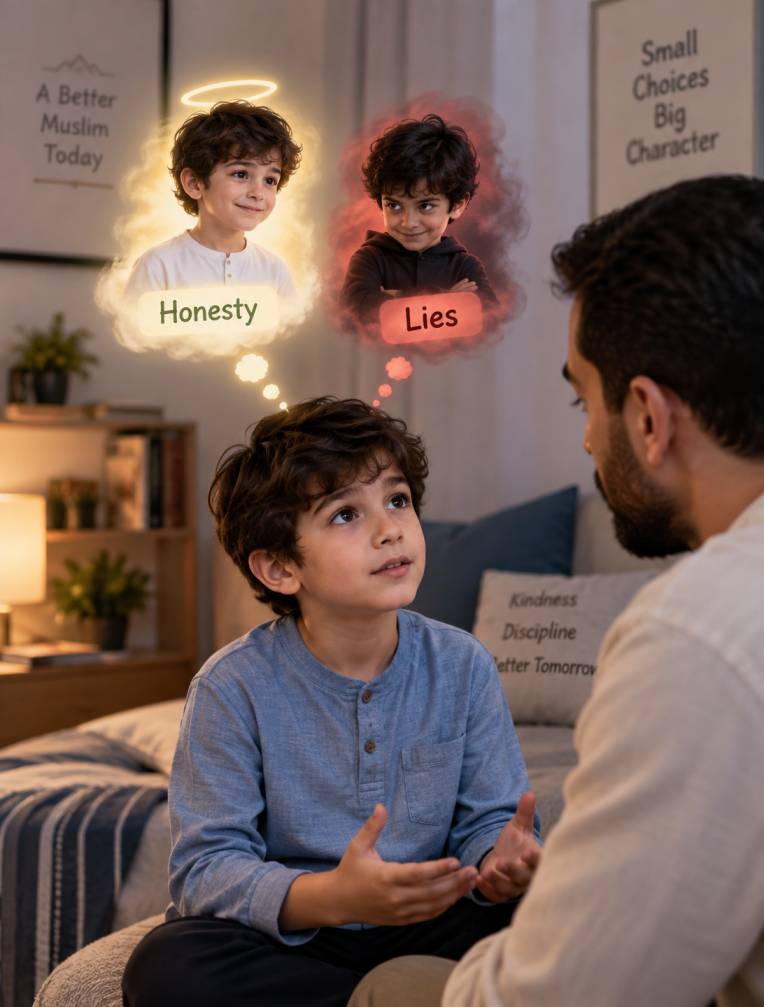
Your child breaks something. You ask what happened. They look straight at you and say it wasn't them, and you know for certain it was.
Almost every parent has stood in that moment. And almost every parent's first instinct is to treat it as a discipline problem: a rule was broken, so a consequence is needed.
But lying is rarely the problem itself. It is usually a symptom. A child who lies is telling you that something in the system that produces honesty has failed, and until you know which part failed, no consequence will fix it. Punishing a child who lied out of fear teaches him to lie better. Explaining the hadith to a child who lied to keep a friend teaches him nothing, because he already knew the rule.
So the useful question is not "how do I stop my child from lying?" It is what makes a Muslim child honest in the first place?
This guide answers that in four parts. It starts with what Islam actually asks of a child, including the difference between three words that get collapsed into one in English. It identifies the five types of lying children do and the specific response each one needs. It lays out the five roots that produce truthful character, and how to tell which one is missing in your own child. And it covers the red flags that mean occasional lying is hardening into a habit.
It is written for parents raising children outside a Muslim-majority society, where honesty carries pressures it doesn't carry elsewhere. If you are working through that broader challenge, our guide to raising Muslim children in a non-Muslim country sets the wider context this article sits inside.
What does Islam say about honesty for children?
Islam treats honesty (sidq) as a path rather than a rule. The Prophet ﷺ taught that truthfulness leads to righteousness and righteousness leads to Paradise, and that a person keeps telling the truth until Allah records him as truthful. For a child, this means honesty is not one good deed but a direction of travel that gradually becomes who they are.
The Arabic word at the center of this topic is sidq (صِدْق). It is usually translated as truthfulness, but it carries more than "not lying." Sidq means correspondence: what is inside a person matches what comes out of them. Their speech matches reality, their actions match their words, and their private self matches their public self. Its opposite, kidhb (كِذْب), is the breaking of that correspondence.
This is why Islam does not present honesty as an isolated good manner. It presents it as a trajectory:
عَلَيْكُمْ بِالصِّدْقِ فَإِنَّ الصِّدْقَ يَهْدِي إِلَى الْبِرِّ وَإِنَّ الْبِرَّ يَهْدِي إِلَى الْجَنَّةِ
"Hold to truthfulness, for truthfulness leads to righteousness, and righteousness leads to Paradise. A man keeps telling the truth and striving for truth until he is recorded with Allah as truthful. And beware of lying, for lying leads to wickedness, and wickedness leads to the Fire. A man keeps lying and pursuing lies until he is recorded with Allah as a liar."
Sahih al-Bukhari 6094 · Sahih Muslim 2607
Read that carefully, because it contains the entire parenting strategy. The hadith does not say a liar is someone who tells a lie. It says a person keeps lying until the description settles on him. Character is described here as an accumulation. One lie does not make a child a liar, and one honest moment does not make him truthful. What matters is which direction the accumulation is running.
That should change how you respond tonight. A single lie is not evidence of a corrupted character, and treating it that way ("How could you? Do you know what Islam says about liars?") is both inaccurate and counterproductive. What you are actually managing is a slope, and your job is to keep tilting it toward truth often enough that truth becomes the default.
The Qur'an frames it the same way, as company and habit rather than a single act. Believers are told to be mindful of Allah and to be with the truthful (9:119), and to speak a word that is straight and sound, qawlan sadidan (33:70). Honesty is positioned as a community you belong to and a way you speak, not a box you tick.
For a fuller picture of how this fits with the other character traits Islam asks parents to build, see our guide on teaching Islamic values to children.
What is the difference between Sidq, Amanah and Wafa' bil-'Ahd?
English collapses three separate Islamic concepts into the single word "honesty." Sidq is truthfulness in speech. Amanah is trustworthiness with what is entrusted to you. Wafa' bil-'ahd is keeping your promises and commitments. A child can be strong in one and weak in another, and each is trained differently.
This distinction matters more than it first appears. Most articles on this topic quote the Prophet ﷺ being called Al-Amin (the trustworthy) and Abu Bakr being called As-Siddiq (the truthful) in the same breath, as if these were two words for the same quality. They are not. They are two different titles describing two different strengths.
When you know which of the three your child is weak in, you stop giving generic advice and start training the actual gap.
Sidq: truthfulness about what happened
This is honesty in its narrowest sense, and it is the one every article covers. It governs the past and the present: reporting reality as it is. A child breaks a glass and says he broke it. A child who fails a test says he failed it. The temptation here is always to escape a consequence that has already been earned.
Amanah: trustworthiness with what is entrusted
Amanah is a wider circle. It covers anything placed in your care: property, information, responsibility, a secret, another person's dignity. The Qur'an commands that trusts be returned to those they belong to (4:58). A child who never lies but reads his sister's private messages, or repeats something told to him in confidence, has strong sidq and weak amanah.
This is the title the Prophet ﷺ held before prophethood. The people of Makkah called him Al-Amin, the trustworthy, because of how he handled what belonged to others, and they continued to deposit their valuables with him even while opposing his message. Note that this is a well-known account from the seerah rather than a hadith, and it is worth telling children as history rather than as a narration.
Wafa' bil-'Ahd: keeping your word
The third pillar governs the future. Sidq is about reporting accurately. Wafa' is about making your future behavior match a commitment you made. "Fulfill the covenant, for the covenant will be asked about" (17:34). Children are almost never taught this as a religious duty, which is why "I promise I'll do it after this game" is treated by most families as a soft phrase rather than a binding one.
آيَةُ الْمُنَافِقِ ثَلَاثٌ إِذَا حَدَّثَ كَذَبَ وَإِذَا وَعَدَ أَخْلَفَ وَإِذَا اؤْتُمِنَ خَانَ
"The signs of a hypocrite are three: when he speaks he lies, when he promises he breaks it, and when he is trusted he betrays."
Sahih al-Bukhari 33 · Sahih Muslim 59
This hadith is usually quoted as a warning about lying. Read it again and notice that it is actually a list of all three pillars in order: speech (sidq), promise (wafa'), and trust (amanah). The Prophet ﷺ named them as three separate failures, which tells us they are three separate capacities.
A practical use for parents
For one week, notice which of the three your child slips on most. Most children are not weak across the board. If the failure is nearly always promises, you have a follow-through problem, not a truthfulness problem, and the fix is smaller commitments kept consistently rather than lectures about lying.
Why do Muslim children lie?
Children lie for five distinct reasons, and each one needs a different response. Fantasy lying is developmental and not really lying. Fear lying avoids punishment. Wishful lying reports what the child wants to be true. Social lying protects standing with peers. Protective lying hides something the child believes must stay hidden. Treating all five the same is why most correction fails.
Before anything else, a piece of reassurance. Almost all children lie, and the ones who lie in early childhood are not showing early signs of bad character. The part of the brain that holds a consequence in mind, weighs it against an immediate impulse, and chooses the harder path is still under construction well into the teenage years. A five-year-old who denies eating the biscuit with chocolate on his chin is not a deceiver. He is a child whose desire to avoid your disappointment has outrun his capacity to manage it.
What matters is that you read the lie correctly. Below are the five types, what each one is telling you, and what to actually do.
Fantasy lying
"A lion came in the garden." "My teacher said I'm the best in the world." The boundary between what happened and what the child imagined is genuinely blurry at this age. This is not deception; it is a mind that has not yet fully separated story from record.
Fear lying
The classic. Something went wrong, a consequence is coming, and the lie is an attempt to escape it. This is the type most parents meet most often, and the one most likely to be made worse by the standard response.
A fear lie is information about your home, not only about your child. It tells you that in your child's estimate, the cost of telling you the truth is higher than the risk of being caught in a lie.
Wishful lying
"I finished my homework." "I read Qur'an today." The child is not reporting the past; he is reporting the version of himself he wishes were true. Often he half-intends to make it true later. Behind it sits shame about falling short, not a plan to deceive.
Social lying
Exaggerating to impress, covering for a friend, going along with a group story, staying quiet while someone else lies. The motive is belonging. At this age a child would often rather be wrong with the group than right alone.
Protective lying
The hardest type, and the one most specific to Muslim families in the West. The child hides something he believes cannot be said: that he skipped salah, that he is being mocked for being Muslim, that he told classmates he isn't fasting, that something happened he thinks you would react badly to.
The lie here is not laziness. It is a judgment your child has made about what your relationship can survive.
Match the response to the cause
Fantasy needs a boundary. Fear needs safety. Wishful thinking needs capacity. Social lying needs a script. Protective lying needs a relationship.
Notice that only one of the five is meaningfully improved by a consequence, and even that one improves more from safety than from severity. This is why a household that responds to every lie identically sees the same lies repeat for years.
Related reading: the most common mistake in Islamic parenting.
What makes a Muslim child honest?
Honesty in a child is produced by five things working together, not by one. He knows Allah sees him, he feels safe telling the truth at home, he sees honesty modeled by his parents, he has words for hard moments, and he connects truth to his identity as a Muslim. Remove any one of the five and the child will lie in a predictable way.
Here is the shift that makes the difference. Honesty is not a switch a child either has flipped on or hasn't. It is an outcome, and outcomes have inputs. When a child lies, one of the inputs is missing, and which one is missing tells you exactly what to do.
We call these the five roots of sidq. Roots, because they are underground: none of them are visible in the moment your child lies to you, which is why the visible behavior is such a poor guide to the actual problem.
Root 1 — He knows Allah sees him (Muraqabah)
Without this, honesty is only risk management. A child whose entire reason for telling the truth is the chance of being caught will lie flawlessly the moment he is certain he won't be. Muraqabah is the awareness that there is no such moment.
This root is built through warmth, not fear. A child who is told "Allah is watching you" only in the second before a punishment learns that Allah is a surveillance system. A child who hears "Allah saw you give that back, and He loves that" learns that Allah is a witness to his good as well. Both statements are true. Which one you use more often decides what the child does when he is alone.
Present: he tells you about something you would never have found out. Absent: he is honest whenever you might discover it and only then.
Root 2 — He feels safe telling you the truth (Amn)
This is the root most often missing in otherwise excellent religious households, and the one parents are least likely to suspect, because it looks like a problem in the child.
Every child runs a quiet calculation: what happens in this house when I say the true thing? If the answer is that truth reliably produces shouting, a lecture, and a punishment, while lying produces a decent chance of nothing, the child is not being immoral when he lies. He is being rational. You have accidentally made truth the more expensive option.
The correction is precise: keep the consequence for the action, and never add a consequence for the confession. A child who admits he broke something still cleans it up. But the admission itself is met with acknowledgment every single time, out loud, so he can hear the transaction working in his favor.
Present: he brings you bad news himself. Absent: he is truthful with teachers and friends but not with you.
Root 3 — He sees honesty in you before he hears it from you (Qudwah)
Children audit adults constantly, and they are very good at it. The phone call you take while telling your child to say you're not home. The excuse given to a relative. The promise of a reward that quietly never arrives.
That last one has a specific narration attached to it, and it is worth knowing that Islam treats it as a real lie rather than a harmless parenting shortcut.
Abdullah ibn Amir reported that his mother called him while the Messenger of Allah ﷺ was sitting in their house, saying "Come here and I will give you something." The Prophet ﷺ asked her: "What did you intend to give him?" She said: "A date." He ﷺ said: "If you had not given him anything, a lie would have been written against you."
Sunan Abi Dawud 4991
This narration is a gift for parents, because it moves the standard from "don't lie to other adults" to "don't lie to your child, even to manage him." Every unkept "in five minutes," every "the doctor said no injection," every "we'll do it tomorrow" that both of you know isn't true, is a lesson delivered more effectively than any lecture on sidq.
Present: he can name a time you admitted you were wrong. Absent: he answers correction with "but you do it too," and he is right.
Root 4 — He has the words for hard moments (Lughah)
A large share of children's lies are not chosen. They are produced under pressure by a child who could not think of anything else to say fast enough. He does not have a sentence that is both true and survivable, so he uses one that is false and easy.
This root is built by rehearsal, not by principle. Give him the actual sentences, and practice them when nothing is at stake:
- To confess: "I need to tell you something and I'm worried about how you'll react."
- To decline covering for a friend: "I wasn't there, so I can't say that happened."
- To refuse without a story: "I don't want to" is a complete sentence and requires no invented excuse.
- To explain a practice: "I don't eat that, it's part of my religion" — said plainly, with no apology and no elaborate cover story.
That last one matters more than it looks, and we return to it below. A child who has no comfortable way to explain being Muslim will often invent one, and the invention is a lie.
Present: he can tell an uncomfortable truth without a meltdown. Absent: he freezes and improvises under any social pressure.
Root 5 — He connects truth to who he is (Hawiyyah)
The final root is the one that holds when you are not present. A rule can be broken; an identity is much harder to act against. The difference is between "I'm not allowed to lie" and "I'm not someone who lies."
Islam supplies the identity language ready-made. Abu Bakr earned the title As-Siddiq because his truthfulness was so established that he believed the account of the night journey without hesitation. The Prophet ﷺ was Al-Amin before he was anything else. The Qur'an describes the siddiqeen in the same verse as the prophets (4:69). These are not abstract virtues; they are names for a kind of person, and children are drawn to becoming a kind of person.
This root also does the heaviest work outside the home, which is why it connects directly to the wider project of building a strong Islamic identity in children, and why its absence is one of the main reasons Muslim children lose their Islamic identity in adolescence.
Present: he is recognizably the same person at home and at school. Absent: he has two versions of himself and manages the gap with lies.
Which root is missing in your child?
The pattern of a child's lying identifies the missing root. A child who is honest only when he might be caught is missing muraqabah. One who lies to parents but not teachers is missing safety. One who lies under peer pressure is missing language. Find the pattern, then work on that root rather than on lying in general.
Use the table below with one specific child in mind, not children in general. Look for the row that describes what actually happens in your house most weeks.
| What you notice | Likely missing root | Where to start this week |
|---|---|---|
| Honest when he might be found out, dishonest when he is sure he won't be | 1 — Muraqabah | Name Allah as a witness to his good, not only his faults. Praise something only Allah and he saw. |
| Truthful with teachers and friends, but lies easily to you | 2 — Safety | Separate the confession from the consequence, out loud, every time, for four weeks. |
| Answers correction with "you do it too," or has stopped taking your word seriously | 3 — Modeling | Keep three small promises exactly as stated. Apologize aloud once for something you got wrong. |
| Lies in groups, or covers for friends, but is honest one to one | 4 — Language | Rehearse three exact sentences he can use when a group expects him to agree. |
| One personality at home, another one outside; hides ordinary things about school | 5 — Identity | Give him language for being Muslim in public that he finds comfortable, not defensive. |
| Claims tasks and worship are done when they clearly aren't | 2 and 4 together | Shrink the expectation until it is genuinely achievable, then make reporting honestly the only thing you measure. |
If more than one row fits, start with root 2. Safety is upstream of everything else. A child who does not feel safe telling you the truth cannot benefit from anything you teach him about truth, because he will not bring you the situations where the teaching would apply.
What are the red flags that lying is becoming a habit?
Occasional lying is normal; a hardening pattern is not. The warning signs are lying with no benefit, lying without hesitation or discomfort, doubling down against clear evidence, keeping different stories for different people, and dishonesty about worship. What matters is the pattern across weeks, not any single incident.
Parents ask this question with real anxiety, so let us be careful with it. Nearly every child lies, most children lie regularly at some ages, and none of that predicts adult character. The concern is not frequency. It is whether lying is still an emergency measure the child reaches for under pressure, or has quietly become his ordinary way of managing life.
The seven red flags worth taking seriously
- Lying when the truth would have served him just as well. This is the most reliable single indicator. When there is no consequence to escape and no advantage to gain, and the child still gives a false version, lying has stopped being a tool and become a reflex.
- The lie comes without hesitation. Early lying is clumsy: a pause, a look away, an obvious tell. When the delivery becomes fluent and calm, the internal resistance that made it uncomfortable has worn down.
- He holds the lie against clear evidence. A child who maintains a denial while looking at proof is no longer trying to convince you. He is protecting a position, and the relationship has become adversarial.
- He keeps different versions for different people. One story for you, another for his other parent, a third for his teacher. This takes real effort to sustain, and a child who is willing to spend that effort has committed to concealment as a strategy.
- He shows no discomfort after being caught. Not defiance — that is normal — but the absence of any impulse to repair. When being caught produces neither embarrassment nor any move to put things right, the internal signal that makes correction possible has gone quiet.
- He has stopped bringing you anything difficult. This one is easy to miss because it looks like peace. If a child who once told you about problems at school now has nothing to report for months, he has not stopped having problems. He has stopped telling you.
- He reports worship he did not perform. "I prayed." "I read my Qur'an." This flag deserves separate attention, because it usually means the child has learned that the honest answer about religious practice is unsafe, and it damages both sidq and his relationship with the practice itself.
How to read all of this
A single flag in a single month is not a diagnosis. Three or more appearing together and persisting for six to eight weeks is a signal that something upstream needs attention, and that signal points at the home environment at least as often as it points at the child. Start with root 2, safety, before anything else. And if the dishonesty appears alongside withdrawal, a sudden change in mood or sleep, secrecy about who your child is with, or anything that makes you worry about their wellbeing, it is worth speaking to your family doctor, a school counselor, or a trusted professional rather than handling it alone.
How do you teach honesty at each age?
The honesty task changes as the child develops. Ages 5 to 7 need the boundary between real and imagined. Ages 8 to 10 need truth to be safe and consistent. Ages 11 to 14 need language for social pressure. Ages 15 to 18 need honesty anchored in identity and reputation rather than in your supervision.
The same five roots apply at every age, but the one that carries the most weight shifts. Teaching a fifteen-year-old the way you taught him at six is the most common reason honesty work stops producing results in adolescence.
Ages 5–7: separate the real from the imagined
At this stage the work is definitional. The child needs a clean, unemotional distinction between the story world and the record of what happened, and he needs it without the word "liar" attached. Introduce the words sidq and kidhb now, in the same casual way you would teach any Arabic vocabulary, so the concept arrives already Islamic rather than being converted later.
Say the thing that will do most of the work at this age: "Allah saw you tell the truth just now, and He loves that." More detail on this stage in our guide to Islamic tarbiyah for children aged 5 to 7.
Ages 8–10: make truth reliably safe
This is the window where the safety root is either built or lost, because the child is now old enough to calculate consequences and young enough to still be forming his default. Say the transaction aloud, every time: the action has a consequence, the confession never does.
It is also the right age to introduce promise-keeping as a religious duty rather than a courtesy, since the child can now hold a commitment across time. See Islamic tarbiyah for children aged 8 to 10 for how this fits with the other habits forming in these years.
Ages 11–14: supply the language for social pressure
The pressure source shifts from you to his peers. He now faces situations you are not in, where the honest answer costs him standing. Abstract principle will not help him here. Specific sentences will.
This is also the age for the harder conversation: the difference between loyalty and complicity. Not confirming a friend's lie is not betrayal, and a friend who requires you to lie for him is asking for something Islam does not permit you to give. Our guide to Islamic tarbiyah for children aged 11 to 14 covers the wider shift happening in these years.
Ages 15–18: hand over the standard
By now supervision has largely ended, and any honesty that depended on it ends with it. What has to be in place is an internal standard: a young person who does not lie because it is inconsistent with who he understands himself to be.
The conversation that works at this age is about the future rather than the rule. What kind of man do you want to be at thirty? What do you want people to assume about your word before you have said anything? That is the Al-Amin conversation, and it lands far better than a hadith quoted as a warning. See Islamic tarbiyah for teenagers aged 15 to 18.
Character is taught in every lesson, not just in Islamic Studies
At Sirat Academy, sidq, amanah and keeping one's word are built into how our Al-Azhar qualified teachers work with your child — in Qur'an, in Arabic, and in Islamic Studies alike.
Book 2 Free Trial Classes No credit card. No obligation. Two live lessons to see the difference.How did the Prophet ﷺ model honesty for children?
The Prophet ﷺ taught honesty by holding the standard in small, easy-to-excuse situations. He warned against lying in jokes, corrected a mother for an empty promise to her child, and was known as Al-Amin before revelation began. The lesson for parents is that honesty is demonstrated in minor moments, not declared in major ones.
Children learn character from behavior under low stakes, because that is where the real standard shows. Three narrations are especially useful to teach, and all three are about small things.
He did not lie even while joking
"Woe to the one who speaks and lies in order to make people laugh. Woe to him, woe to him."
Sunan Abi Dawud 4990 · Jami' at-Tirmidhi 2315
This closes the exception children reach for most: that a lie doesn't count if it was funny. It is worth pairing with the fact that the Prophet ﷺ joked often and was known for his good humor. The point is not that Muslims are humorless. It is that humor never required falsehood.
He counted an empty promise to a child as a lie
The narration quoted earlier, in which a mother called her son with the offer of something and the Prophet ﷺ told her a lie would have been recorded had she not given it (Sunan Abi Dawud 4991), is the single most useful hadith in this entire topic for parents. It closes the second exception: that a lie doesn't count if it was told to a child, for the child's own management.
He was Al-Amin before he was anything else
Before revelation, the people of Makkah entrusted their valuables to Muhammad ﷺ and called him Al-Amin. When the message came and they opposed it, they still kept their deposits with him. Their disagreement was with what he said; their assessment of his trustworthiness had already been settled by twenty years of ordinary transactions.
Tell this to a child as history, because that is what it is — an account from the seerah rather than a hadith. And draw the actual lesson from it: a reputation is not built by declaring your honesty. It is built by small consistent conduct over years, until other people conclude it for themselves.
Aisha reported that no behavior was more hateful to the Messenger of Allah ﷺ than lying, and that when he learned a man had lied in his presence, it stayed with him until he knew the man had repented (Jami' at-Tirmidhi 1973). This is worth mentioning to older children specifically because it shows a standard held internally, not enforced externally.
What should you do when your child lies to you?
Do not interrogate, offer a way back, and never punish the confession. Pause before reacting, avoid asking questions you already know the answer to, give one clear second chance, acknowledge the truth out loud when it comes, and keep the consequence attached to the action rather than to the admission.
- Pause before you respond. The first three seconds set the price of truth in your home for the next several months. Nothing you say in those three seconds is more valuable than what your silence buys you.
- Do not ask a question you already know the answer to. "Did you do this?" while holding the evidence is a trap, and your child knows it is a trap. Say instead: "I can see the screen was on after bedtime. Tell me what happened."
- Offer one clear second chance. "I think something different happened. Do you want to try that again?" Then honor it completely if he takes it. A second chance that is followed by punishment is worse than no second chance, because it teaches him that the offer is bait.
- Name the truth-telling out loud. "Thank you for telling me. That was hard and you did it." He needs to hear the reward exist, in words, in the moment. Otherwise the lesson does not register.
- Keep the consequence on the action only. The broken thing still gets repaired, the missed homework still gets done. But he must be able to see that the confession itself cost him nothing.
What if you have already handled it badly?
Most parents reading this will recognize that they have punished a confession before, possibly many times. This is repairable, and repairing it is more powerful than never having done it, because your child gets to watch you model the thing you are asking of him.
Say it plainly, without a long speech and without conditions: "Last week you told me the truth and I shouted at you. That was wrong of me. I want you to be able to tell me things, so I am going to handle it differently." Then hold to it, because the first time he tests it will decide whether he believes you.
Owning a mistake in front of your child is not a loss of authority. It is root 3 and root 2 being repaired in the same sentence, and there is no lecture that accomplishes as much. Our article on helping a child love Islam rather than fear it works through the same principle across other areas of practice.
What pressures honesty for Muslim children in the West?
Muslim children in Western countries face a pressure most honesty guides miss: dishonesty about identity. Alongside ordinary temptations to lie, they are pushed toward hiding practice, minimizing beliefs, and managing two versions of themselves. That gap between the public self and the private self is exactly what sidq forbids.
Everything above applies to any child anywhere. This section does not. It covers four pressures that arise specifically from being visibly Muslim in a society where that requires explanation, and it is the reason honesty deserves a place in your wider work of raising Muslim children in a non-Muslim country.
1. Lying to avoid explaining
"I already ate." "I'm not hungry." "I have a thing after school." Small false statements used to avoid a conversation about halal food, salah, or Ramadan. The motive is not shame; it is fatigue at being the one who always has to explain.
The fix is root 4. A child who has one comfortable, unapologetic sentence ready will use it. A child who has to compose one under pressure every time will eventually reach for a cover story instead.
2. Academic dishonesty as a norm
Shared homework, group chats during assessments, a general sense that everybody does it. When dishonesty is the surrounding norm rather than an individual failure, "don't cheat" carries very little weight against it.
This is where the amanah framing earns its place. Cheating is not primarily lying; it is a betrayal of a trust, which is a separate and heavier category. Naming it correctly changes how it feels.
3. The curated online self
Social platforms reward a version of a person rather than the person. For a Muslim teenager the gap often runs in a specific direction: a public self with the Islam edited out.
Frame this as sidq rather than as a screen-time argument. Sidq means the inside matches the outside. A profile that requires you to hide who you are is not a neutral tool; it is an ongoing act of misrepresentation.
4. Two selves, managed by lies
The most serious of the four. A child who behaves one way at home and another way outside must lie continuously in both directions to keep the two from meeting. The lying is not the disease; it is the maintenance cost of a split identity.
No amount of honesty training fixes this. What fixes it is root 5, and the work of building an Islamic identity a child does not need to hide.
It is worth saying clearly that the answer to all four is not withdrawal from society. Honesty, accountability and keeping your word are qualities Muslims can recognize and appreciate wherever they find them, and Islam has never required cultural isolation to preserve character. Our article on what Muslims can learn from Western culture works through where that line sits.
Is it ever allowed to lie in Islam?
Islam permits departing from the literal truth in three narrow situations only. Umm Kulthum bint Uqbah reported that the Prophet ﷺ permitted it in war, in reconciling between people who are estranged, and between a husband and wife. Everything outside those three remains prohibited, and none of them apply to a child avoiding a consequence.
Umm Kulthum bint Uqbah reported: "I did not hear him permit anything of what people call lying except in three things: in war, in reconciling between people, and in a man's talk with his wife and a woman's talk with her husband."
Sahih Muslim 2605 · Riyad as-Salihin 249
Older children will find this exception and test it, so it is better that they hear it from you with its limits intact than discover it framed as a loophole.
Three things are worth making explicit. First, the exceptions concern preventing harm and repairing relationships, never personal advantage — which excludes every situation in which a child is tempted to lie. Second, scholars have discussed at length whether these cases involve outright falsehood or the use of indirect speech, ma'arid, in which a person says something technically true that leaves a different impression. That distinction is worth knowing precisely because it shows how carefully the tradition guarded the boundary rather than opening it. Third, and most usefully for a teenager: notice that none of the three exist to make life easier for the person telling them.
There is a related question children ask, about kindness. If a relative gives a gift you dislike, must you say so? No. Islam does not require you to volunteer every true thing you think. Choosing what to say is not the same as saying what is false. "That was kind of you, thank you" is entirely true and complete.
Which Islamic words and duas should you teach?
Teaching the Arabic terms makes honesty feel Islamic rather than generic. The core vocabulary is sidq (truthfulness), kidhb (lying), amanah (trustworthiness), siddiq (deeply truthful) and amin (trustworthy). Paired with a short du'a, this gives a child language for a value rather than only a rule about it.
Children absorb values faster when the value has a name in the language of their faith. "Don't lie" is a household rule. "We are people of sidq" is an identity, and identity is root 5.
- صِدْق — Sidq: truthfulness; what you say matches what is real.
- كِذْب — Kidhb: lying; the break between the two.
- أَمَانَة — Amanah: trustworthiness with what is placed in your care.
- صِدِّيق — Siddiq: one whose truthfulness has become their defining quality. Abu Bakr's title.
- أَمِين — Amin: one who can be trusted. The Prophet's title before revelation.
رَبِّ أَدْخِلْنِي مُدْخَلَ صِدْقٍ وَأَخْرِجْنِي مُخْرَجَ صِدْقٍ وَٱجْعَل لِّي مِن لَّدُنكَ سُلْطَانًا نَّصِيرًا
"My Lord, cause me to enter a sound entrance and to exit a sound exit, and grant me from Yourself a supporting authority."
Surah Al-Isra 17:80
This du'a is ideal for this topic because the word sidq appears twice in it: the entrance of truth and the exit of truth. Teach an older child to notice that, and the du'a becomes a daily reminder rather than a recitation.
For younger children, the Prophet ﷺ used to ask in his night prayer: ٱهْدِنِي لِأَحْسَنِ ٱلْأَخْلَاقِ لَا يَهْدِي لِأَحْسَنِهَا إِلَّا أَنْتَ — "Guide me to the best of character, for none guides to the best of it but You" (Sahih Muslim 771). Short enough to memorize, and it frames good character as something asked for rather than achieved alone.
A seven-day honesty practice for your home
One week of deliberate practice will tell you which root is missing. The plan below works on your own behavior first, then on your child's, because in most households the fastest change comes from adjusting how truth is received rather than from teaching more about why it matters.
- Day 1 — Audit yourself. Count every small untruth you say in front of your child, including "tell them I'm busy" and promises you don't intend to keep. Just count. Don't change anything yet.
- Day 2 — Stop the trap questions. Do not ask a single question you already know the answer to. Replace each one with a statement of what you saw.
- Day 3 — Say the transaction out loud. The first time your child admits anything, name it: "You told me yourself. That matters." Then apply the consequence for the action only.
- Day 4 — Keep three small promises exactly. Say what you will do, state the time, and do it. Small ones. This is root 3, and it is faster to repair than most parents expect.
- Day 5 — Teach the words. Introduce sidq, kidhb and amanah in ordinary conversation, without a lesson attached.
- Day 6 — Rehearse the hard sentences. Practice two scripts with your child when nothing is at stake. What to say when a friend asks him to confirm something untrue. What to say when someone asks why he doesn't eat something.
- Day 7 — Repair one thing. Apologize for one occasion where you handled his honesty badly. Then say what you will do instead.
At the end of the week, return to the diagnostic table above. In most homes the picture is noticeably clearer, and one root has become obviously the weakest.
Faith, character and identity — taught together
Sirat Academy teaches Muslim children in the USA, UK, Canada, Australia and across Europe. Our Islamic Studies course covers akhlaq and adab alongside fiqh, aqeedah and seerah — taught in English by Al-Azhar qualified teachers who work with children growing up in the West.
Start With 2 Free Trial Classes Personalized level assessment · Flexible scheduling · No obligationFrequently asked questions
Children can grasp the difference between real and imagined from around age five, and can understand lying as a moral wrong from around age seven, when the ability to weigh consequences develops. Before that, introduce sidq as a positive value Allah loves rather than as a prohibition. Framing it as haram to a four-year-old attaches guilt to imagination, which is not what the ruling addresses.
Lying when there is nothing to gain is the most meaningful warning sign, because it suggests lying has become a reflex rather than a tool. That said, one isolated period is not a pattern. Watch for six to eight weeks and look for the other flags: fluency without hesitation, doubling down against evidence, and an absence of discomfort once caught. If three or more persist together, work on safety at home first.
Apply the consequence to the action, never to the confession. If a child breaks something and admits it, the repair still stands but the admission must cost him nothing. Punishing the confession teaches him that truth is the expensive option and lying is the cheaper one, which is precisely the calculation that produces habitual lying.
Sidq is truthfulness in what you say: your report matches reality. Amanah is trustworthiness with what is entrusted to you, whether property, information or responsibility. A child can have strong sidq and weak amanah — never lying, but reading a sibling's private messages. Keeping a promise, wafa' bil-'ahd, is a third distinct duty covering future commitments.
Start with the narration that truthfulness leads to righteousness and righteousness leads to Paradise (Sahih al-Bukhari 6094, Sahih Muslim 2607), because it presents honesty as a direction rather than a single act. For older children, the three signs of a hypocrite (Bukhari 33, Muslim 59) covers lying, breaking promises and betraying trust in one narration.
Islam permits departing from the literal truth in three narrow cases only: war, reconciling estranged people, and between spouses (Sahih Muslim 2605). Social convenience is not among them. However, choosing not to volunteer a hurtful truth is not lying. Saying "thank you, that was kind of you" about an unwanted gift is entirely true, and children benefit from learning that discretion and dishonesty are different things.
Add one element to the usual approach: give your child comfortable language for being Muslim in public. Many lies told by Muslim children in the West are not about misbehavior at all — they are cover stories used to avoid explaining halal food, prayer or Ramadan. A child who has a plain, unapologetic sentence ready does not need to invent one. Our guide to raising Muslim kids in a non-Muslim country covers the wider identity work this sits inside.