Learn How to Pray: A Step-by-Step Guide to Salah
One complete Rak‘ah, explained movement by movement — with illustrated drawings, the words to say in each position, and how the same cycle builds the five daily prayers.
The Harakat of Salah are the sequence of physical movements performed during Islamic prayer. In this guide, we will learn how to pray by taking one complete Rak‘ah step by step — from Takbirat al-Ihram and the standing recitation, to Ruku‘ (bowing), rising from Ruku‘, Sujud (prostration), sitting between the two prostrations, and the second Sujud.
We will also explain what to say during each position, including the main recitations and supplications, and then show how the same Rak‘ah sequence is repeated to perform the five daily prayers: Fajr, Dhuhr, ‘Asr, Maghrib, and ‘Isha.
To make the steps easier to understand and follow, this article is supported by illustrative drawings showing the correct position and movement for each stage of Salah.
Whether you are learning how to pray for the first time or you are teaching your child to pray, this step-by-step guide will help you understand the Harakat, recitations, and Rak‘ahs of the daily prayer.
What Is a Rak‘ah in Salah?
A Rak‘ah is one complete cycle of the movements and recitations that make up Salah. A basic Rak‘ah includes standing and reciting, Ruku‘ (bowing), standing upright again, Sujud (prostration), sitting between the two prostrations, and a second Sujud. Once you can perform one Rak‘ah, you have learned the foundation of all five daily prayers.
Everything else in the daily prayer is a repetition of this one cycle. Fajr repeats it twice. Maghrib repeats it three times. Dhuhr, ‘Asr, and ‘Isha repeat it four times. That is why beginners should not try to memorize five different prayers — there is really only one sequence to learn, and then a number to remember for each prayer.
Figure 1 · The Rak‘ah cycle
One Rak‘ah, six positions, one loop
The six positions always follow the same order. Each daily prayer simply repeats this loop.
What Do You Need to Do Before You Start Praying?
Before beginning Salah you should face the Qiblah, be in a state of purification, wear clothing that is appropriate for prayer, have a clean and suitable place to pray, and know which of the five daily prayers you are performing. Once these five conditions are met, you can begin.
These are not optional details you add later. They are the conditions that make the prayer valid, so it is worth taking a moment to check them before you raise your hands. For most beginners the part that needs the most practice is Wudu (ablution), so learn that first — the movements of Salah come easily afterwards.
-
Condition 01
Face the Qiblah
Turn toward the Ka‘bah in Makkah. A compass app is enough to find the direction from anywhere in the world.
-
Condition 02
Be in a state of purification
Perform Wudu before you pray. If your Wudu has been invalidated since the last prayer, renew it.
-
Condition 03
Wear appropriate clothing
Clothing must be clean and cover what is required for prayer for a man or a woman.
-
Condition 04
Pray in a clean place
The spot where you stand, bow, and prostrate should be clean and free of anything impure.
-
Condition 05
Know which prayer it is
Fajr, Dhuhr, ‘Asr, Maghrib, or ‘Isha — be clear in your heart which prayer you are performing.
How Do You Pray Step by Step?
To pray one Rak‘ah: stand facing the Qiblah and say Allahu Akbar, place your right hand over your left and recite Al-Fatihah followed by a short Surah, bow in Ruku‘, rise upright, prostrate in Sujud, sit briefly, then prostrate a second time. That completes one Rak‘ah.
Below, each of those eight movements is shown with an illustration, the words said in that position, and the details that beginners most often get wrong. Take them one at a time. It is far better to learn two positions properly this week than to rush through all eight and repeat the same mistakes for years.
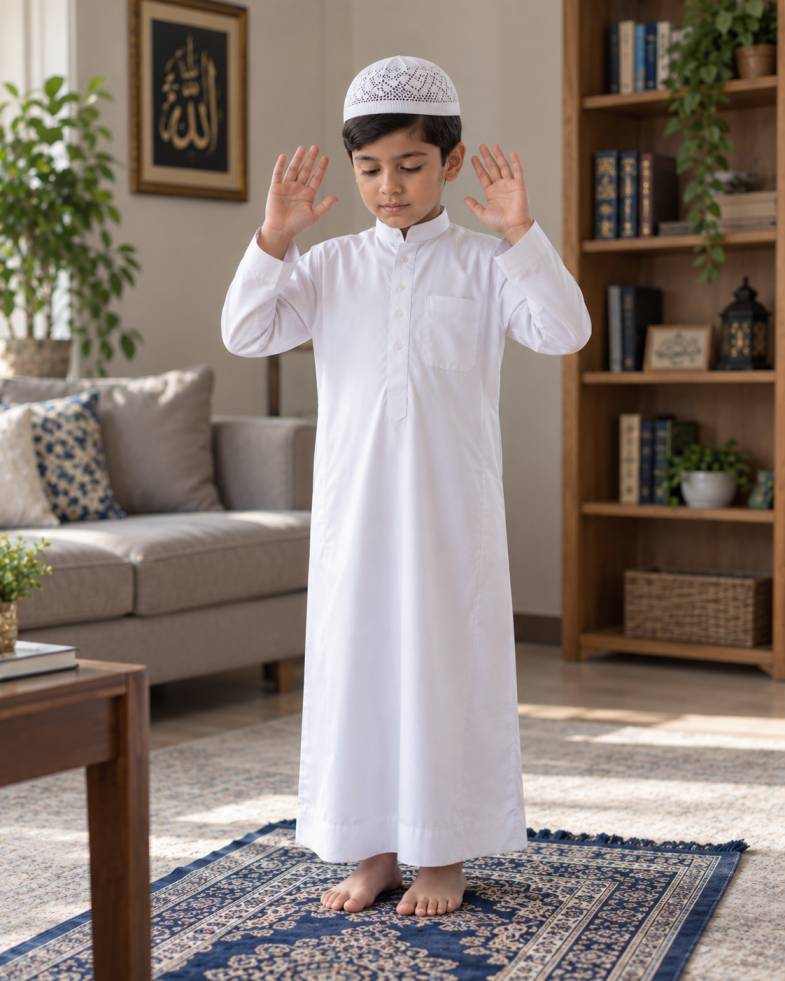
Step 1 — Takbirat al-Ihram: hands raised, fingers slightly spread, at shoulder or ear level.
Stand and Begin with Takbirat al-Ihram
Stand upright while facing the Qiblah. Raise your hands and say:
This opening declaration is known as Takbirat al-Ihram — the Takbir that enters you into the state of prayer. From this moment onward, you are in Salah, and ordinary speech and movement are set aside.
- Keep your fingers slightly spread rather than tightly clenched together.
- Raise your hands to roughly the level of your shoulders or ears.
- Say the Takbir clearly — audibly enough that you can hear yourself.
After saying Allahu Akbar, lower your hands into the position used for standing during Salah.
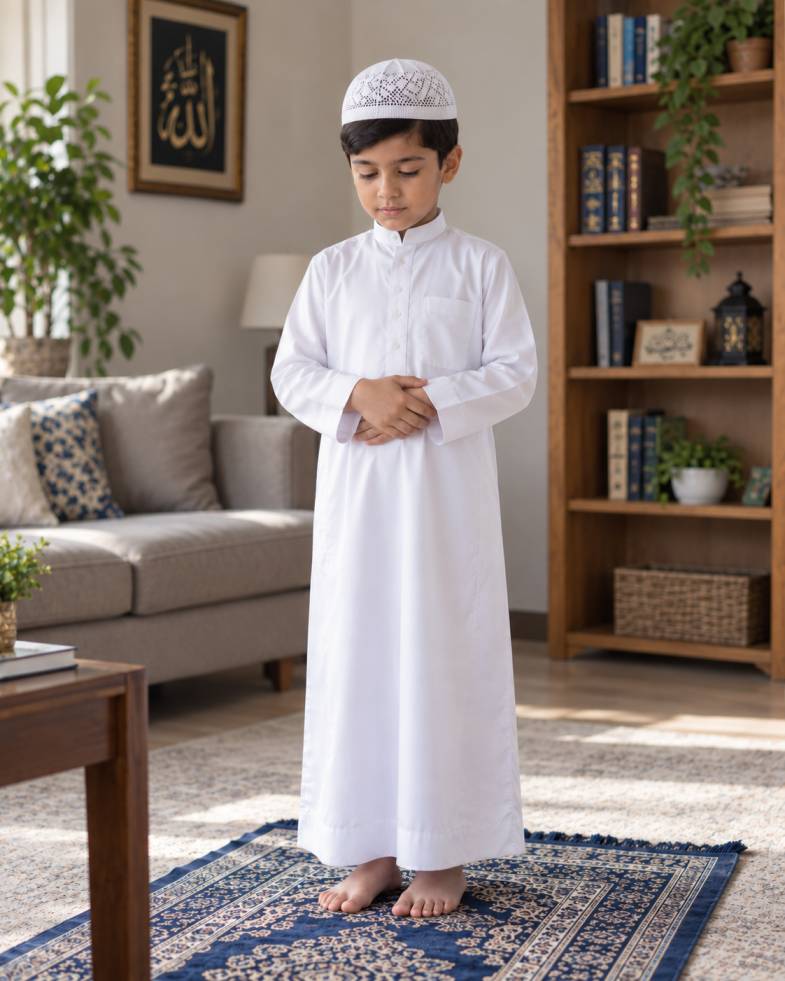
Step 2 — The standing position (Qiyam): right hand over the left, holding the wrist or forearm.
Place Your Hands and Begin Recitation
Place your right hand over your left hand, holding the wrist or the forearm. The source material used for this guide places the hands above the navel and below the chest.
After this, you may recite the opening supplication known as Du‘a al-Istiftah. This supplication is Sunnah, meaning it is recommended rather than an essential part of the prayer.
Step 3 — Recitation: Al-Fatihah first, then a short Surah or a few verses.
Recite Al-Fatihah and Another Surah
Next, recite Surah Al-Fatihah from beginning to end. Al-Fatihah is recited in every single Rak‘ah of every prayer — it is the one Surah you cannot pray without, so it is always the first thing a beginner should memorize.
Then recite a short Surah or some verses from the Qur’an. For someone who is just beginning to learn how to pray, starting with the short Surahs at the end of the Qur’an makes memorization far easier.
The important thing is to learn gradually and practice consistently rather than becoming overwhelmed by trying to memorize everything at once. If reciting Arabic letters correctly is the obstacle, an Arabic reading course is usually the fastest way forward, and a Tajweed course will refine the pronunciation once you can read.
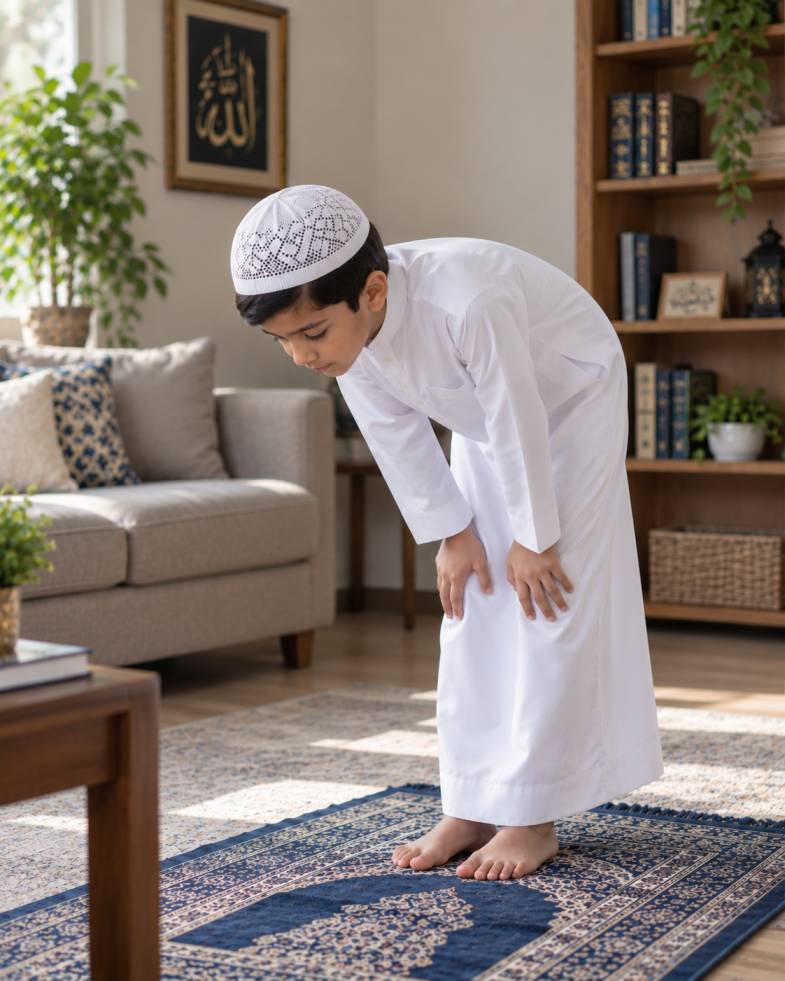
Step 4 — Ruku‘: back straight and approximately horizontal, gaze toward the place of prostration.
Perform Ruku‘
After completing the recitation, say Allahu Akbar and move into Ruku‘, the bowing position. Keep your back straight and approximately horizontal while maintaining a stable position, with your gaze directed toward the place of prostration.
What should Ruku‘ look like?
- Keep your back as straight as reasonably possible.
- Maintain a stable, settled position — do not rock or wobble.
- Keep your gaze toward the place of prostration.
- Do not rush through the movement.
Learning Salah is not about performing the movements as quickly as possible. Calmness and proper posture are part of the prayer itself, not an optional refinement.
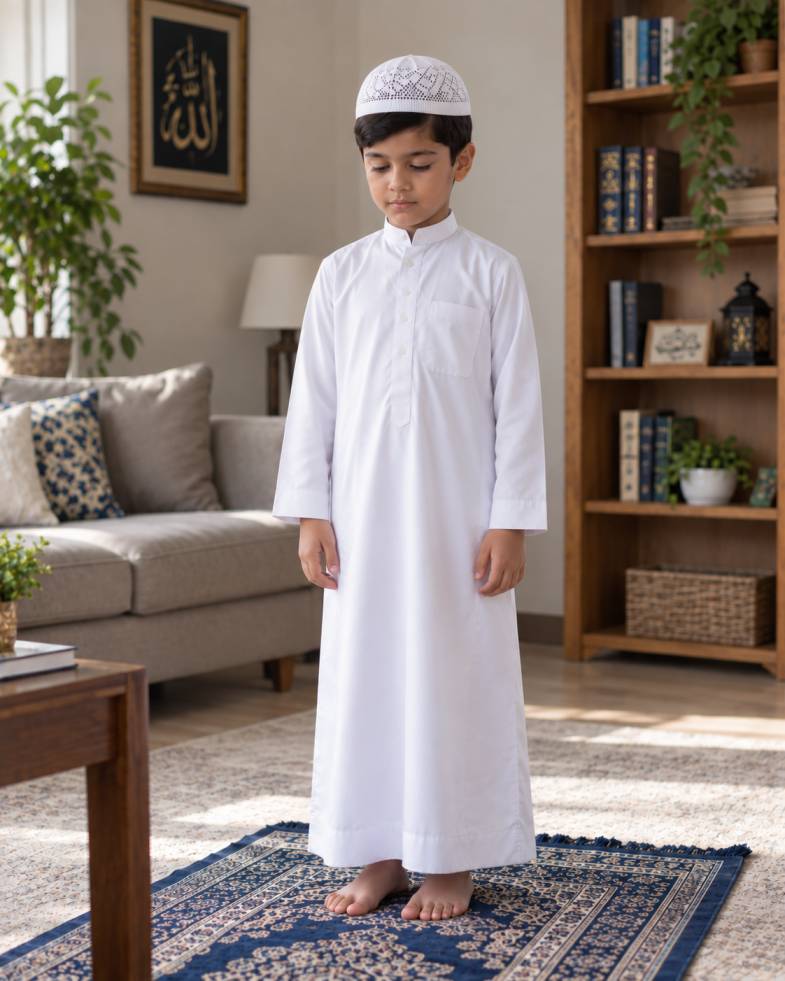
Step 5 — I‘tidal: rise fully upright and pause calmly before descending into Sujud.
Rise from Ruku‘
From Ruku‘, rise back to a completely upright standing position while saying:
Once you are standing upright, say:
Then pause calmly before moving into the next position. This transition is important. Do not drop straight into Sujud before you have become fully upright — it is one of the most common errors in the prayer of beginners and of people who have prayed for years.
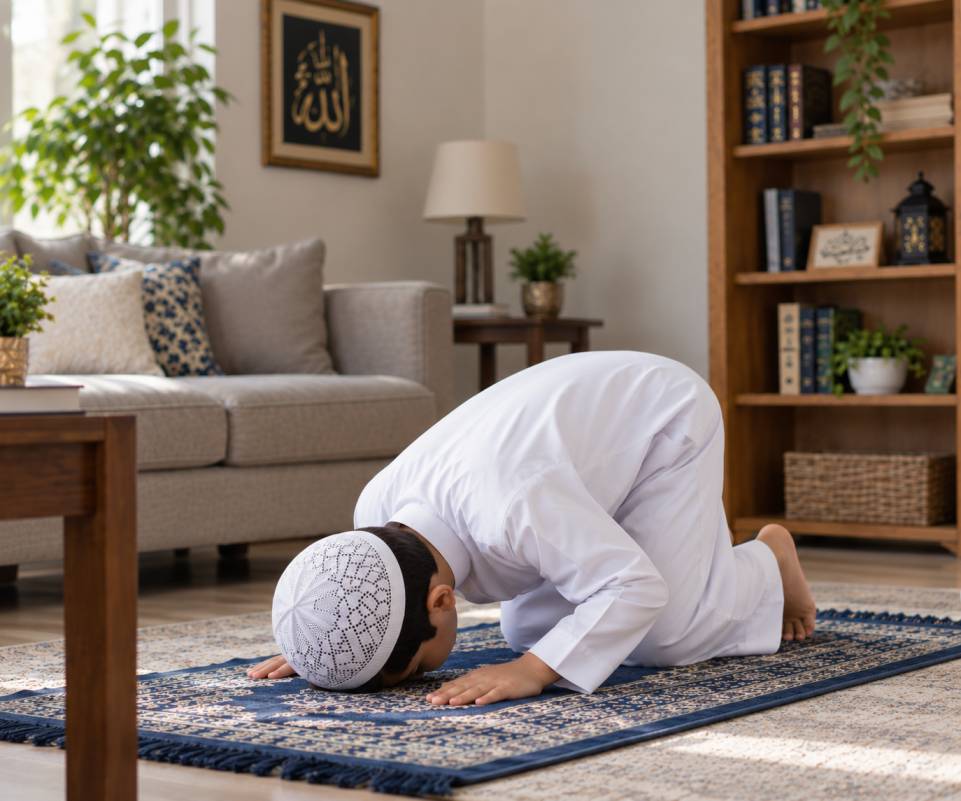
Step 6 — Sujud: forehead and nose on the ground, elbows off the ground, arms away from the sides.
Perform the First Sujud
After standing upright, say Allahu Akbar and move down into Sujud, or prostration. The source material recommends descending knees first, following the majority position. During Sujud, make sure your forehead and the tip of your nose touch the ground, and keep your body extended rather than tightly curled.
- Keep your elbows off the ground.
- Keep your arms away from your sides.
- Keep your hands positioned toward the Qiblah.
- Keep your fingers together.
- Place your forehead and nose firmly on the ground.
Sujud is one of the most meaningful positions in Salah — the moment a servant is closest to their Lord. It is therefore important to perform it calmly rather than treating it as simply another movement in a sequence.
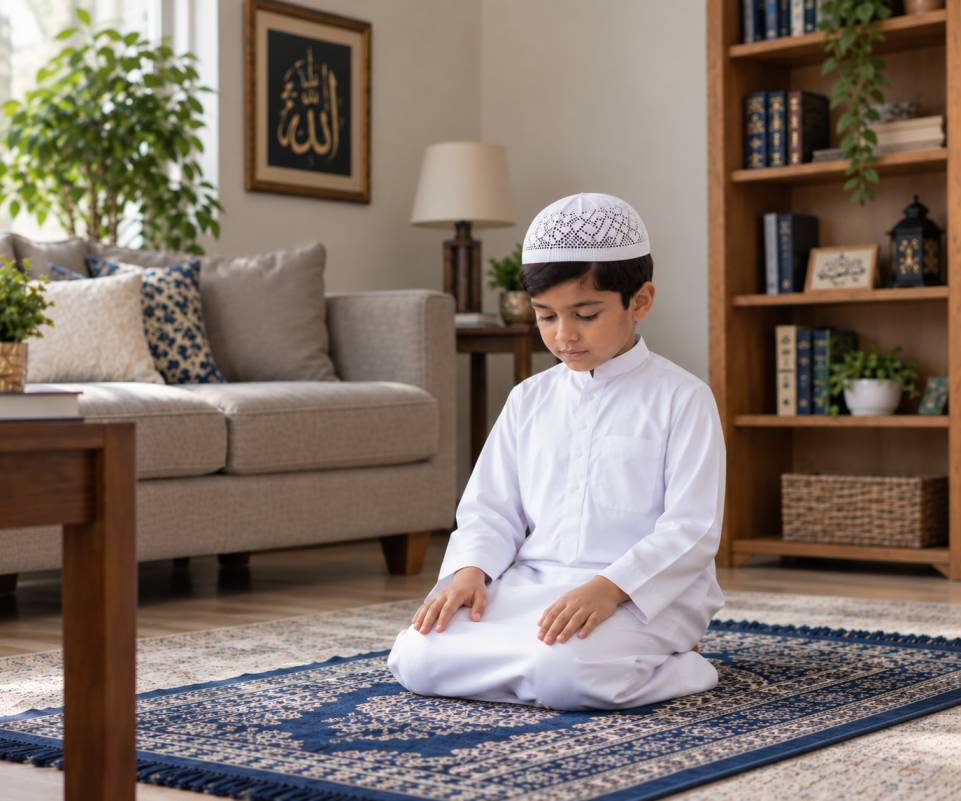
Step 7 — Julus: sitting calmly and upright between the two prostrations.
Sit Between the Two Sujuds
After the first Sujud, say Allahu Akbar, then rise and sit calmly and upright.
If you have not memorized this supplication yet, the source material indicates that you can pause calmly for approximately the duration of one glorification while you are still learning. The important point for a beginner is not to rush through this position — it is a genuine pillar of the Rak‘ah, not a gap between two prostrations.
Step 8 — The second Sujud completes the Rak‘ah.
Perform the Second Sujud
From the sitting position, say Allahu Akbar, then perform the second Sujud in the same basic manner as the first. Again recite Subhana Rabbiyal-A‘la three times.
How Many Rak‘ahs Are in the Five Daily Prayers?
The five obligatory daily prayers contain 17 Rak‘ahs in total: Fajr has 2, Dhuhr has 4, ‘Asr has 4, Maghrib has 3, and ‘Isha has 4. Fajr is recited audibly, Dhuhr and ‘Asr are recited quietly, and Maghrib and ‘Isha begin audibly then continue quietly.
Once you have learned one Rak‘ah, the next step is understanding how that Rak‘ah fits into each of the five prayers. Nothing new is added — the same cycle simply repeats.
| Prayer | Rak‘ahs | Recitation | Details |
|---|---|---|---|
| Fajr | 2 | Audible | The recitation is audible in both Rak‘ahs. |
| Dhuhr | 4 | Quiet | The recitation is performed quietly throughout. |
| ‘Asr | 4 | Quiet | The recitation is performed quietly throughout. |
| Maghrib | 3 | Audible Quiet | The first two Rak‘ahs include audible recitation; the third is recited quietly. |
| ‘Isha | 4 | Audible Quiet | The first two Rak‘ahs include audible recitation; the last two are recited quietly. |
Figure 2 · Rak‘ahs and recitation
17 obligatory Rak‘ahs across the day
Each block is one Rak‘ah. Green blocks are recited audibly; gold blocks are recited quietly.
Reaching this point is a real milestone. You now know the movements, the words, and the structure of every obligatory prayer in the day. What remains is practice — and, for most learners, some correction from a teacher who can actually see how you pray. That is exactly what our Islamic Studies course is built for: Fiqh of worship taught live, one to one, with your recitation and posture corrected as you go.
How Long Does It Take to Learn How to Pray?
With regular practice, many children learn the basic movements and sequence of Salah in about 2–4 weeks, while adults often learn the basic sequence in about 1–2 weeks. Becoming comfortable with the required recitations and performing the complete prayer confidently usually takes several weeks to a few months.
For children, learning is usually more gradual because they are learning both the Harakat (movements) and the Arabic recitations at the same time. A child may first learn the basic positions, then gradually memorize Al-Fatihah, the essential phrases of Ruku‘ and Sujud, and finally the remaining supplications.
Adults who already know some Arabic or have previous exposure to Salah may progress more quickly. Beginners with no Arabic or Islamic background will usually need additional time to memorize the recitations — and that is completely normal.
The best approach is to learn one part of Salah at a time, practice regularly, and gradually build accuracy and confidence. The goal is not simply to finish memorizing the steps quickly, but to learn how to perform Salah correctly and understand what you are saying.
Figure 3 · Typical learning timelines
Movements come first — recitation takes longer
Indicative ranges with consistent daily practice. Every learner is different, so treat these as guides rather than deadlines.
What Is the Best Order for Learning How to Pray?
The most effective order is: learn Wudu first, then Takbirat al-Ihram and Surah Al-Fatihah, then the Harakat (movements) with their recitations, then the Tashahhud and Taslim, and finally the number of Rak‘ahs and audible or silent recitation for each of the five daily prayers.
Learners who try to absorb everything at once usually stall. Learners who follow a sequence — purification, then opening, then movements, then completion, then structure — tend to be praying independently within weeks.
Figure 4 · The learning path
Four stages from Wudu to a complete prayer
Each stage rests on the one before it. Do not move up until the stage below feels comfortable.
-
Stage 1 · Purify
Before the prayer
- Wudu (ablution), step by step
- Conditions: Qiblah, clothing, clean place
- Prayer times and which prayer is due
-
Stage 2 · Open
Entering the prayer
- Takbirat al-Ihram
- Surah Al-Fatihah
- Two or three short Surahs
-
Stage 3 · Move
The Harakat
- Ruku‘, I‘tidal, Sujud, Julus
- Salah recitations & supplications
- Calmness and correct posture
-
Stage 4 · Complete
Finishing & structure
- Tashahhud and final Tashahhud
- Taslim (ending the prayer)
- Rak‘ahs, audible and silent recitation
What Are the Most Common Mistakes in Salah?
The most common mistakes in Salah are rushing between positions without settling, failing to straighten up fully after Ruku‘, resting the elbows on the ground during Sujud, reciting Al-Fatihah incorrectly, and treating the sitting between the two prostrations as a pause rather than a genuine position of the prayer.
Rushing the movements
Moving to the next position before the body has settled. Every position needs a moment of stillness.
Not standing fully upright
Dropping into Sujud while still bent forward from Ruku‘. Straighten completely first.
Elbows on the ground
In Sujud the elbows stay raised and the arms stay away from the sides.
Mispronouncing Al-Fatihah
Small pronunciation errors change meaning. This is where Tajweed correction matters most.
Skipping the sitting
The sitting between the two prostrations is a position of prayer, not a gap between them.
Losing track of Rak‘ahs
Common when the mind wanders. Praying with presence solves this better than counting harder.
How Do You Teach a Child These Steps?
Teaching a child to pray is a different task from learning yourself. Children need the movements before the meanings, praise before correction, and the experience of praying beside a parent before any expectation of praying alone. The Prophet ﷺ instructed that children be taught prayer around the age of seven — the same window in which lifelong habits take root.
Our full parent guide, how to teach your child to pray, covers the age-by-age approach, what to do when a child resists, and how to build Salah into a family routine that lasts. If your child is at the earliest stage, start with Islamic Tarbiyah for children aged 5–7, which sets the foundation of love and habit that Salah grows out of.
And if the Arabic itself is the barrier — if your child can copy the movements but cannot yet read what they are reciting — a structured Qur’an course with a qualified teacher will move things forward faster than repetition at home alone.
اهْدِنَا الصِّرَاطَ الْمُسْتَقِيمَ
Ready to Start Learning How to Pray?
Start with one lesson. Build the knowledge. Practice the movements. Understand the meaning. And gradually make Salah a lasting part of daily life. Sirat Academy currently offers 2 free trial classes as part of its learning plans — for children and adults alike.
Frequently Asked Questions About Learning Salah
A Rak‘ah is one complete cycle of movements and recitations in Salah. It consists of standing and reciting, Ruku‘ (bowing), standing upright again, Sujud (prostration), sitting between the two prostrations, and a second Sujud. Every daily prayer is simply this cycle repeated two, three, or four times.
Fajr has 2 Rak‘ahs, Dhuhr has 4, ‘Asr has 4, Maghrib has 3, and ‘Isha has 4 — 17 obligatory Rak‘ahs in total each day. Fajr is recited audibly, Dhuhr and ‘Asr are recited quietly, and Maghrib and ‘Isha begin audibly in the first two Rak‘ahs then continue quietly.
In Ruku‘ you say Subhana Rabbiyal-‘Azeem (“Glory be to my Lord, the Most Great”), traditionally three times. In Sujud you say Subhana Rabbiyal-A‘la (“Glory be to my Lord, the Most High”), also three times. Rising from Ruku‘ you say Sami‘a Allahu liman hamidah, then once upright, Rabbana wa lakal-hamd.
With consistent practice, most adults learn the basic sequence of Salah in about 1–2 weeks and children in about 2–4 weeks. Performing the complete prayer confidently, with the required recitations memorized, usually takes several weeks to a few months depending on age, prior Arabic knowledge, and how regularly the learner practices.
The Prophet ﷺ instructed that children be taught prayer around the age of seven. In practice, many families introduce the movements earlier by letting a child stand beside a parent during Salah, then teach the recitations gradually from around age five to seven, when children are most ready to form lasting habits.
No. Du‘a al-Istiftah, the opening supplication recited after Takbirat al-Ihram, is Sunnah — recommended rather than essential. A beginner should focus first on the essential recitations and movements, then add the recommended supplications once the core prayer feels natural.
Surah Al-Fatihah is recited in every Rak‘ah of every prayer, which is why it should be the first thing a beginner memorizes. After Al-Fatihah you say Ameen, and in the first Rak‘ahs you then recite a short Surah or a few verses from the Qur’an.
Yes. Live one-to-one online classes work well for Salah because a teacher can see your posture and hear your recitation, then correct both in real time — which is exactly what reading alone cannot do. Sirat Academy teaches the Fiqh of prayer, Qur’an, and Tajweed online with Al-Azhar graduate teachers, and offers 2 free trial classes so you can test the format first.