Sirat Academy · Parenting Guide
✦ For Muslim parents of children aged 5–7Islamic Tarbiyah for Children Aged 5–7
A practical guide to raising a child who loves Allah, follows the Sunnah, and grows up proud of their Islamic identity.
Raising a Muslim child in today's world isn't easy — especially when your family is surrounded by values that don't always align with Islam.
If your child is between the ages of 5 and 7, you are shaping the habits, beliefs, and character that may stay with them for life. This practical guide to Islamic Tarbiyah for children will help you understand what truly matters at this age and how to nurture a child who loves Allah, follows the Sunnah, and grows up proud to be Muslim.
The Foundation
What Is Islamic Tarbiyah for Children Aged 5–7?
Many parents think Islamic Tarbiyah simply means teaching their children how to read the Qur'an, memorize Surahs, or learn Hadith. While these are essential parts of a Muslim's education, they are only one part of the journey.
Tarbiyah is not just about what a child knows — it is about who a child becomes.
A child may memorize the entire Qur'an yet still struggle with honesty, kindness, gratitude, or love for Allah if these values are not nurtured alongside knowledge. True Islamic Tarbiyah focuses on developing the heart, building noble character (Akhlaq), strengthening faith (Iman), and helping children live Islam in their everyday actions.
Knowledge
Teaches what Islam says
Surahs, du'as, rulings, and facts. Vital — but on its own, information a child can recite without it shaping how they live.
Tarbiyah
Teaches how to live it
Love of Allah, character, and habits woven into daily life — so faith becomes part of who your child is, not just something they were told.
When both grow together, children practice Islam because it becomes part of who they are.
Between the ages of 5 and 7, children are like fertile soil. Whatever is planted during these years begins to take root. This is why Tarbiyah at this age is not about raising little scholars — it is about raising children who love Allah, respect others, speak the truth, pray willingly, and feel proud of building a strong Islamic identity.
The Critical Window
Why Are the Ages of 5–7 So Important in Islam?
The years between five and seven are among the most formative in a child's life. During this stage, children begin to develop the beliefs, habits, and character traits that will shape how they think and make decisions as they grow.
Modern developmental science supports this. Research from the Center on the Developing Child at Harvard University explains that early childhood is a critical time for developing executive function skills — the brain's ability to focus attention, control impulses, remember instructions, and plan ahead. These skills aren't inherited fully formed; they are shaped through everyday routines and the guidance of caring adults.
Figure 1 · Developmental Readiness by Age
The window for shaping faith & character peaks early
Relative readiness of a child's brain to form lifelong habits, routines, and character (illustrative, based on early-childhood developmental research).
"Command your children to pray when they are seven years old…"
— Sunan Abu Dawud
This hadith is more than an instruction about Salah. It recognizes that around this age, children become ready to build lifelong habits, understand responsibility, and develop self-discipline. Rather than focusing only on memorizing information, use this precious stage to plant the seeds of Iman, good manners, love for Allah, and pride in being Muslim.
How They Learn
How Children Learn at This Age
Children between five and seven experience the world very differently from adults. They are naturally curious and constantly observing — and they learn far more from what they see than from what they are told.
Developmental psychologists describe this stage as a time of learning through observation, imitation, repetition, and experience. Children watch how their parents react to challenges, speak to others, pray, and express gratitude to Allah. These everyday moments quietly shape their understanding of Islam and life.
At this age, children have vivid imaginations and are emotionally driven. They are far more likely to remember a heartfelt story about Prophet Muhammad ﷺ than a long lecture about good manners. They respond to encouragement more than criticism, and are motivated by love, praise, and belonging.
This is why Tarbiyah should never feel like a classroom of rules and memorization. Invite your child to pray beside you instead of simply telling them to. Let them hear you say Alhamdulillah when something good happens and Astaghfirullah when you make a mistake. Read stories of the Prophets before bed, involve them in kindness, and celebrate the beauty of being Muslim.
Your child is always learning — even when you are not teaching. During these precious years, you are your child's first teacher, but more importantly, their first example of Islam.
Where to Aim
What Should Parents Focus On Between 5 and 7?
Children this age aren't ready for long lectures or deep discussions. They learn through repetition, imitation, and everyday experience. Instead of teaching them everything about Islam at once, focus on building simple habits they will carry for life — all pointing toward the same centre.
Figure 2 · The Tarbiyah Compass
Eight habits, one direction
Every daily habit is a spoke pointing toward the same centre — the straight path (aṣ-ṣirāṭ al-mustaqīm).
- 1Help them love AllahChildren should know Allah loves them, provides for them, and hears their du'a. Avoid making Allah seem frightening or only linked to punishment.
- 2Make Salah a family experienceDon't expect perfect prayer. Let your child stand beside you and feel happy to join — build love for Salah before consistency.
- 3Teach simple daily du'asStart with short du'as for everyday moments: before eating, before sleeping, entering and leaving the home.
- 4Build good manners, one habit at a timeSaying Assalamu Alaikum, sharing, telling the truth, respecting parents. This is the heart of teaching Islamic values to children.
- 5Tell stories of the ProphetsChildren remember stories far better than lectures. Make them part of bedtime, and highlight one simple lesson each time.
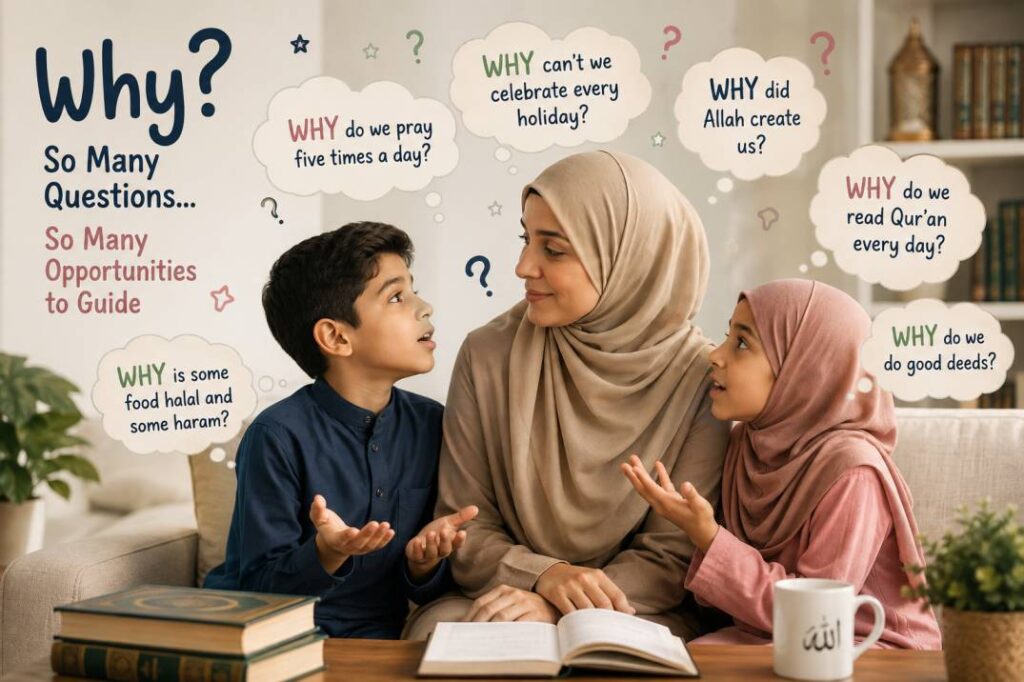
- 6Encourage questionsWelcome their curiosity and answer patiently, so talking about Allah and Islam feels natural rather than formal.
- 7Limit harmful influencesPay attention to what your child watches, listens to, and imitates. Screens and friends shape behaviour too.
- 8Fill childhood with positive Islamic memoriesRamadan decorations, Eid, the Qur'an at home, mosque visits — a child with happy memories of Islam stays attached to it.
The Prophetic Model ﷺ
What Did Prophet Muhammad ﷺ Teach About Childhood?
The Prophet ﷺ did not teach parents through speeches alone — he showed them through his actions. Every interaction with a child was filled with mercy, patience, and wisdom. His example reminds us that Tarbiyah begins by winning a child's heart before trying to shape their behaviour.
He allowed children to be children
While leading prayer, his grandsons Al-Hasan and Al-Husayn climbed onto his back in sujood. Instead of rushing them, he remained in prostration longer than usual until they climbed down themselves. Afterward he explained: "My son was riding on my back, and I did not want to disturb him until he had finished." (Ahmad & An-Nasa'i)
He made children feel special
When young Um Khalid bint Khalid (رضي الله عنها) visited, he placed a beautiful cloak on her himself and said affectionately, "Sanah, Sanah!" — "May you wear it for a long time." He never ignored children for being young; he made them feel noticed and loved.
He taught through everyday moments
Eating with young Umar ibn Abi Salamah (رضي الله عنه), he gently guided rather than scolded: "Young boy, mention the name of Allah, eat with your right hand, and eat from what is in front of you." (Bukhari & Muslim) A family meal became a lesson in manners and worship.
He showed that love is strength
He often kissed his grandsons. When a man remarked that he never kissed his own children, the Prophet ﷺ replied: "Whoever does not show mercy will not be shown mercy." (Bukhari & Muslim) For him, affection was not weakness — it was essential to raising righteous children.
The lesson for parents: He loved before he corrected, listened before he instructed, and built relationships before he expected obedience. If we want to raise children who love Islam, we begin where the Prophet ﷺ began — with mercy, affection, patience, and sincere companionship.
Your Living Example
The Importance of Being a Role Model
One of the greatest mistakes parents make is believing children learn mainly from instructions. In reality, children aged 5–7 learn far more from what they see than from what they hear. Every day, they are quietly watching, listening, and copying the people they love most.
The morning du'a
Every morning, a father raises his hands: "O Allah, bless my day, protect my family, and guide me to what pleases You." His six-year-old watches silently. Days later, before school, the little boy raises his tiny hands and repeats exactly what he saw.
The football match
Another father shouts insults at the television when his team misses a goal. His son says nothing — but a week later, missing a shot with friends, the same words come out of his mouth. "Where did you learn those words?" The answer is simple: from him.
Children are mirrors. If they see patience, they learn patience. If they hear gratitude, they become grateful. Before asking, "What should I teach my child today?", ask yourself: "What did my child see me doing today?" Because long before children follow our advice, they follow our example.
Rhythm of the Day
Building an Islamic Daily Routine
Children thrive on routine. When Islam becomes part of everyday life — not just a weekly lesson — it gradually becomes part of who they are. The goal isn't to fill every minute with lessons, but to weave the remembrance of Allah naturally into ordinary moments.
| Time | Daily Habit |
|---|---|
| Morning | Wake with the morning du'a, make the bed, wash up, and thank Allah for a new day. |
| Breakfast | Say Bismillah before eating and Alhamdulillah after finishing. |
| Before School | Read one short du'a together and remind your child that Allah is always watching over them. |
| After School | Spend 10–15 minutes talking about their day: what made them happy, what they learned, whether they helped someone. |
| Afternoon | Read or listen to one short story from the Qur'an or the Seerah (5–10 min) and discuss one simple lesson. |
| Prayer Time | Invite your child to pray beside you. Don't worry about perfection — let them enjoy the family prayer. |
| Play Time | Encourage active play, creativity, and good friends. Childhood is a blessing meant to be enjoyed. |
| Before Bed | Read the bedtime adhkar, recite a short Surah, make du'a for family, and end with a warm hug and kind words. |
Five minutes of sincere, consistent Tarbiyah every day is far more powerful than one long lesson once a week. Each evening, ask: Did my child hear the Qur'an today? Did we pray together? Did they learn one good manner? Did they laugh with me? Did they sleep feeling loved by me and by Allah?
The Foundation of It All
It All Starts With Love
If there is one secret to successful Islamic Tarbiyah, it is this: children learn best from those they love and trust.
Many parents believe righteous children are raised through constant correction, strict rules, and frequent reminders. Discipline has its place — but it is love that opens a child's heart to learning. Think about your own childhood: you probably don't remember every lesson, but you remember how your parents made you feel. A child who feels loved, safe, and valued is far more willing to listen, imitate, and accept guidance.
This is exactly how the Prophet ﷺ raised the next generation. Before teaching people what to do, he won their hearts with mercy and compassion. When your child knows you love them unconditionally, they come to you with questions, admit mistakes, and accept advice. Your relationship becomes the bridge through which faith and values pass from your heart to theirs.
But when love is missing, Tarbiyah becomes much harder. A child who only hears criticism may associate Islam with pressure instead of peace. A child ruled by fear may obey while young — but once the fear fades, so may their motivation. Rules without love produce resistance; love with wise guidance builds lasting conviction.
This doesn't mean letting children do whatever they want. True love includes guidance, boundaries, and correction — given with gentleness and wisdom, so children know that even when corrected, they are deeply loved. In Tarbiyah, love is not the reward for success — it is the foundation that makes success possible.
Keeping It Alive
When Your Child Gets Bored With Islamic Learning
Almost every child gets bored from time to time — and that's perfectly normal. The solution isn't longer lessons, but making Islamic learning enjoyable, interactive, and part of everyday life. Teach through stories, games, role-play, crafts, and family challenges. Tell the stories of the Prophets with excitement, reward good manners with praise, and let your child participate in worship instead of only watching.
Most importantly, don't make every conversation about correcting mistakes. Let your child experience the beauty of Islam through happy memories — visiting the mosque, decorating for Ramadan, giving charity together, preparing Eid gifts. Children don't fall in love with Islam because they are forced to study it; they fall in love with it when they experience its beauty through the people they love most. If this is your struggle, our guide on how to make your child love Islam without forcing them goes deeper.
Parenting Abroad
Common Challenges Muslim Parents Face in Western Countries
Raising Muslim children in the West comes with challenges previous generations may not have faced. Every day, children are exposed to ideas, celebrations, friendships, and lifestyles that may not reflect Islamic values. The most common challenges include:
- Peer pressure to fit in with classmates
- Exposure to inappropriate content on TV, YouTube, social media, and online games
- Confusion between Islamic values and what they see at school
- Feeling different because they pray, dress modestly, or celebrate different holidays
- Limited time with practicing Muslim friends
These challenges are real, but they shouldn't make parents feel hopeless. Understanding why some Muslim children gradually lose their Islamic identity is the first step to preventing it. Children raised in a loving Islamic home — surrounded by positive role models and a strong community — are far more likely to grow confident in their faith. For a complete framework, see our guide to raising Muslim kids in a non-Muslim country.
The goal is not to isolate children from society, but to prepare them to live confidently as Muslims within it — respecting everyone while remaining proud of the values Allah has given them.
The Foundations
What Should Your Child Learn Before Turning Eight?
Every child develops at a different pace, so this is not a checklist to create pressure — think of it as the foundations Tarbiyah aims to build before age eight. By this age, your child should ideally:
Figure 3 · Readiness Foundations by Age 8
What a strong foundation looks like
The emphasis shifts from information toward heart, habit, and character.
A Realistic Plan
A Practical Weekly Tarbiyah Plan for Parents
Raising a righteous child isn't about doing something extraordinary once a month. It's about small, meaningful things done consistently every week. Here is a simple plan any busy family can follow.
| Day | Simple Tarbiyah Activity |
|---|---|
| Monday | Read one short story from the Qur'an or a Prophet's life and discuss one lesson. |
| Tuesday | Practice one Islamic manner — honesty, gratitude, kindness — and praise your child when they show it. |
| Wednesday | Memorize one short du'a and use it together at the right time of day. |
| Thursday | Spend 10–15 minutes on Allah's blessings — ask what your child is grateful for today. |
| Friday | Dress nicely for Jumu'ah, share a story about the Prophet ﷺ, and make plenty of du'a together. |
| Saturday | Visit the mosque, meet practicing Muslim friends, or do an act of charity as a family. |
| Sunday | Enjoy family time with no lessons — play, laugh, and strengthen your bond. A strong bond is one of the greatest tools of Tarbiyah. |
Figure 4 · Consistency vs. Intensity
Why 15 minutes daily beats one long weekly lesson
Meaningful touchpoints with Islam per month — habits form through frequency, not duration.
Remember: consistency matters more than quantity.
The Real Scorecard
How to Measure Success in Your Child's Tarbiyah
Many parents measure success by asking, "How many Surahs has my child memorized?" Memorization is valuable — but it's only one part of Tarbiyah. Instead, ask yourself:
- Does my child willingly join me for Salah?
- Do they say Bismillah or Alhamdulillah without being reminded?
- Do they tell the truth, even after a mistake?
- Do they show kindness to siblings, parents, and friends?
- Do they enjoy listening to stories about the Prophets?
- Do they feel happy and proud to be Muslim?
- Do they ask about Allah and Islam with curiosity?
If the answer to most is yes, your Tarbiyah is moving in the right direction. Success is not raising a child who knows the most — it's raising a child whose heart is connected to Allah and whose character reflects Islam.
Course Corrections
Common Tarbiyah Mistakes to Avoid
Every parent makes mistakes, and no family is perfect. The goal isn't perfection but continuous improvement. Avoiding a few common mistakes makes the journey much smoother.
- Focusing on memorization more than character.Teaching the Qur'an is essential, but manners, honesty, kindness, and mercy should grow alongside knowledge.
- Expecting adult behaviour from a child.Children 5–7 will forget, get distracted, ask endless questions, and make mistakes. Be patient — this is childhood.
- Using fear more than love.If children only hear about punishment, they may fear Islam instead of loving it. Teach Allah's mercy and forgiveness alongside right and wrong.
- Being inconsistent.Teaching your child to pray while neglecting your own Salah sends mixed messages. Children believe what they see more than what they hear.
- Comparing your child to others.Every child learns differently. Comparison damages confidence — celebrate progress, no matter how small.
- Waiting for someone else to raise your child.Schools, Qur'an teachers, and academies are valuable partners, but they can't replace parents. The home is where Tarbiyah begins.
Your child doesn't need perfect parents. They need parents who sincerely strive to bring them closer to Allah, one day at a time.
You're Not Alone
When Should You Seek Extra Support?
We are our children's first teachers — no one can replace the love and influence of a parent. But that doesn't mean we have to do it alone. Seeking support is often one of the best decisions you can make for your child's Tarbiyah. You may benefit from extra guidance if:
- Your child is losing interest in learning about Islam
- You find it hard to keep a consistent Islamic routine at home
- Your child asks questions you don't know how to answer
- You want your child to learn the Qur'an or Islamic Studies from qualified teachers
- You live in a non-Muslim country with limited access to practicing Muslim families
- A busy schedule makes regular Islamic education difficult
Seeking help isn't a sign of failure — it's a sign of wisdom. Just as we find qualified teachers for maths or science, our children deserve knowledgeable teachers who can help them build a strong relationship with Allah. The best results come when parents and teachers work together toward the same mission.
Your Partner in Tarbiyah
How Sirat Academy Supports Muslim Families in the West
At Sirat Academy, we understand the unique challenges of raising children in Western countries. Your goal isn't only for your child to memorize the Qur'an — you want them to grow into a confident Muslim who loves Allah, practices with sincerity, and stays proud of their Islamic identity wherever they live.
That's why our approach goes beyond information. Every lesson is designed to strengthen your child's faith, character, and love for Islam in a warm, supportive environment. Our qualified teachers — graduates of Al-Azhar University — use interactive methods suited to each child's age and personality, making every lesson meaningful and enjoyable. Your child can learn:
- 📖 Qur'an & Hifz
- ✨ Tajweed
- 🔤 Arabic Reading
- 🗣️ Arabic Language
- 🌙 Islamic Studies
Our lessons are delivered online, accessible to families across the UK, USA, Canada, Australia, and beyond. And we work hand in hand with parents — because the strongest Tarbiyah happens when the home and the teacher share the same mission.
Parent Questions
Frequently Asked Questions
At what age should I start Islamic Tarbiyah for my child?
What is the difference between Islamic Tarbiyah and teaching the Qur'an?
How much time should I spend on Islamic Tarbiyah each day?
How do I keep my 5–7 year old interested in learning about Islam?
Should I teach my child about Allah using fear or love?
What should my child know before turning eight?
اهدِنَا الصِّرَاطَ المُستَقِيمَ "Guide us to the straight path." — Surah Al-Fatihah, 6
Give your child the gift of faith, confidence, and identity
If you're looking for more than an online Islamic class — a partner who will help you nurture your child's faith, character, and confidence — we'd be honoured to be part of your family's journey. Book your two free trial lessons today.