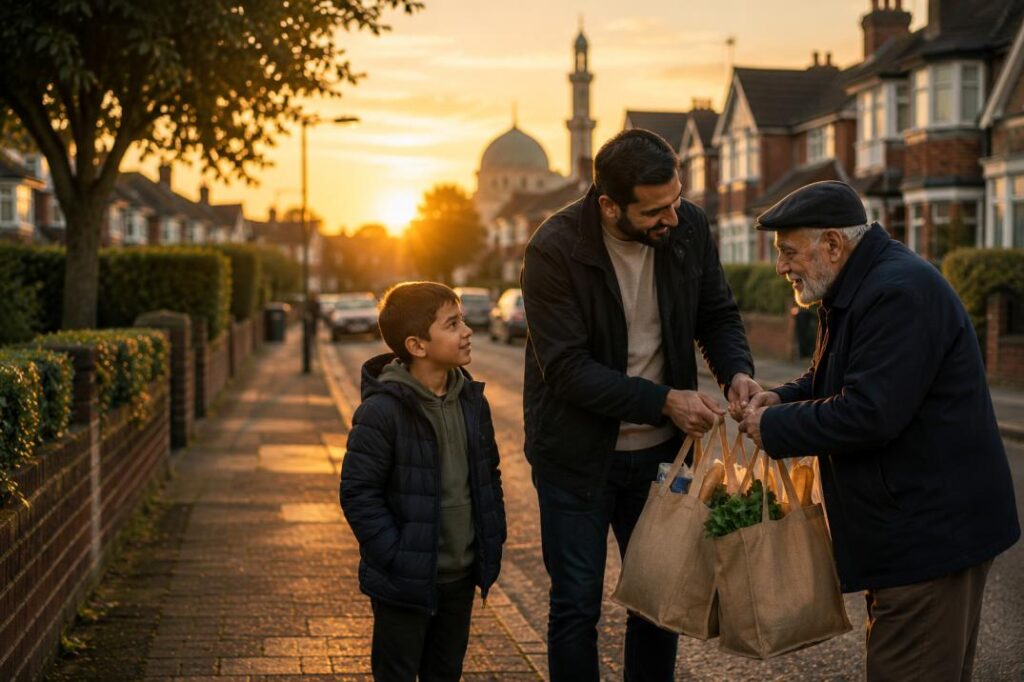
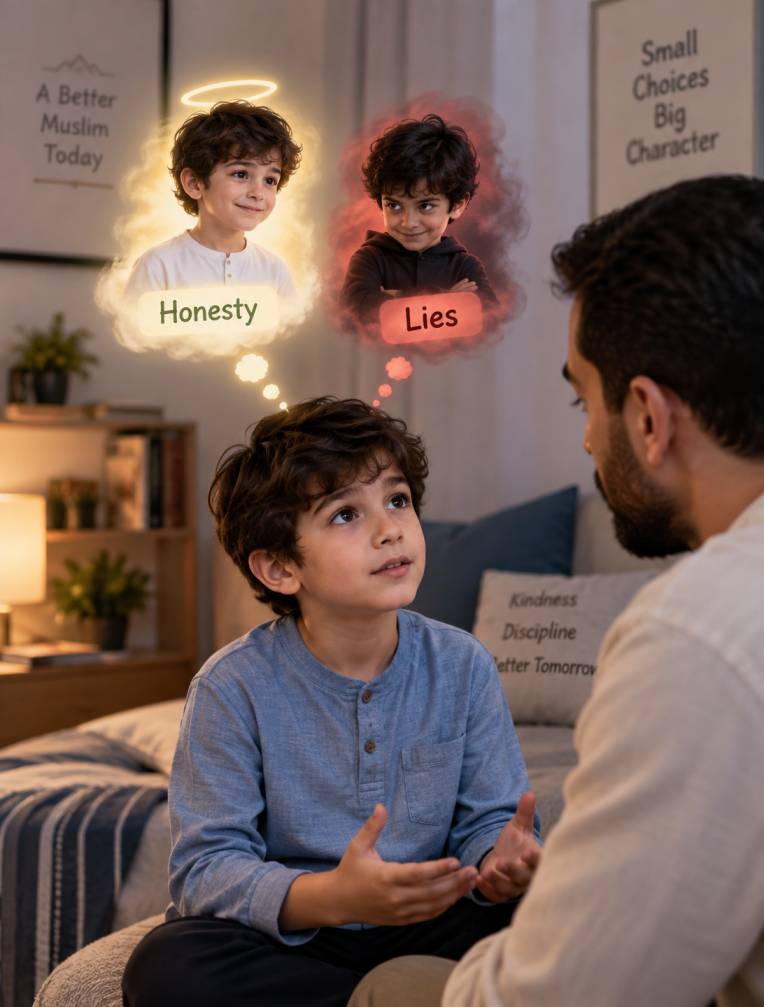
Akhlaq for Kids: 7 Islamic Manners Every Parent Must Teach
A practical, age-by-age guide for Muslim parents raising children in the West — what to teach, how to teach it, and what to do when it isn't working.
What This Guide Covers
Most Muslim parents can tell you how many surahs their child has memorized. Far fewer can tell you how their child behaved the last time a younger sibling broke something of theirs.
That gap is the heart of the matter. Akhlaq for kids — the building of Islamic character and manners — is not a supplement to religious education. In the prophetic model it is the purpose of it. A child who memorizes beautifully but lies easily has learned the words of Islam without absorbing its shape.
This guide covers the seven core Islamic manners every child needs, what each one realistically looks like at different ages, the practical methods that actually move behavior, and — the part most articles skip — what to do when your child keeps doing the thing you have told them fifty times not to do.
What Is Akhlaq in Islam?
Akhlaq (أخلاق) is the Islamic term for a person's inner character and moral disposition — the settled habits of the heart that produce behavior without conscious effort. The singular, khuluq, shares a root with khalq (creation), which carries a striking implication: character is understood as a second creation, an inner form shaped over time the way the body was shaped at birth.
This is why Islam treats character as something built rather than something possessed. A child is not simply kind or unkind. A child is being shaped, daily, by what is modeled, reinforced, ignored, and excused in the home.
وَإِنَّكَ لَعَلَىٰ خُلُقٍ عَظِيمٍ
"And indeed, you are of a great moral character."
Qur'an 68:4
Allah praises the Prophet ﷺ here not for his knowledge, his lineage, or his worship, but for his khuluq. When his wife A'ishah (may Allah be pleased with her) was asked to describe his character, her answer was that his character was the Qur'an — that is, he was the Qur'an lived out in a human being (Sahih Muslim 746).
Adab vs. Akhlaq: What's the Difference?
Parents use these two words interchangeably, but the distinction matters enormously for how you teach.
Adab is the outward etiquette. Akhlaq is the inward character that produces it. Adab is the correct action in a given situation. Akhlaq is the state of heart that makes the correct action feel natural.
| Adab (Etiquette) | Akhlaq (Character) |
|---|---|
| Saying JazakAllahu khayran | Actually feeling grateful |
| Not interrupting an elder | Genuinely valuing what they say |
| Sharing a toy when told to | Noticing that someone else wants it |
| Apologizing after a fight | Feeling the weight of having hurt someone |
Adab can be trained through instruction and repetition. Akhlaq cannot be instructed into existence — it grows through modeling, explanation, and repeated experience over years.
The practical consequence: if you only teach adab, you get a child who performs manners in front of you and drops them the moment you leave the room. Adab is the entry point. Akhlaq is the destination. You teach the first in order to reach the second, and you reach the second only by consistently explaining the why behind the first.
Why Akhlaq Outweighs Memorization
Islam does not present good character as a nice addition to religious practice. It presents it as the measure of religious practice.
"I was only sent to perfect good character."
Musnad Ahmad 8952; Al-Adab Al-Mufrad 273 — graded sahih
The word "only" in this narration is doing heavy lifting. The Prophet ﷺ is summarizing his entire mission in a single objective, and that objective is character.
"Nothing is placed on the scale that is heavier than good character."
Sunan Abi Dawud 4799; Jami' at-Tirmidhi 2002 — graded hasan sahih
And a third, which reframes what excellence means:
"The best among you are those with the best character."
Sahih al-Bukhari 6035
Read those three together and a clear order emerges. Character is the mission, the heaviest deed, and the standard of excellence. Memorization, Arabic, and fiqh are not diminished by this — they are the container that carries it. But a container without contents is just a container. This is why our Islamic Studies program at Sirat Academy is built around character formation rather than information delivery: the aim is not a child who can recite the definition of sidq, but a child who tells the truth when it costs them something.
The Real Challenge of Raising Kids in the West
Generic advice about manners fails Muslim families abroad because it does not address the specific collisions your child actually experiences. Three of them come up in nearly every parent conversation we have:
1. "Speak your truth" versus sidq
Your child's school teaches that honesty means expressing whatever they feel. Islam teaches that truthfulness is an obligation toward objective reality, tempered by wisdom and kindness. A ten-year-old hears "be authentic" at school and "control your tongue" at home, and reasonably concludes that the adults disagree. Unless you name the difference explicitly, the louder, more socially rewarded message wins.
2. Respect as hierarchy versus respect as equality
Western classrooms frequently model peer-level relationships with adults — first-name basis, debating the teacher, expressing disagreement openly. Islamic adab assigns a genuine status to age and knowledge. Children are not confused by having two frameworks; they are confused when nobody tells them there are two, and when each is appropriate.
3. The visibility problem
A Muslim child in a Western school is often the only one, or one of very few. Every manner they practice is visible and therefore social risk: saying salaam, refusing something haram at a birthday party, stepping away to pray. Good akhlaq costs your child something socially that it would not cost a child in Cairo or Karachi.
This is the part parents consistently underestimate. Your child is not lazy about their manners — they are calculating a social cost you are not paying. The answer is not more pressure. It is giving them language, confidence, and a reason strong enough to carry the cost. We cover this terrain in depth in our guide to raising Muslim children in a non-Muslim country.
The 7 Core Akhlaq Every Muslim Child Needs
These seven are not an arbitrary selection. Each has a direct Qur'anic or prophetic root, each is teachable from early childhood, and together they cover a child's relationship with Allah, with family, with peers, and with creation.
1. Respect — Ihtiram
Respect in Islam is recognizing the rightful standing of another person and letting that recognition govern your speech and behavior. It is not fear, and it is not silence. A child can disagree respectfully; a child cannot dismiss respectfully.
فَلَا تَقُل لَّهُمَآ أُفٍّ وَلَا تَنْهَرْهُمَا وَقُل لَّهُمَا قَوْلًا كَرِيمًا
"Say not to them a word of disrespect, nor repel them, but speak to them a noble word."
Qur'an 17:23
The precision of this verse is worth pointing out to an older child. Allah does not prohibit shouting at parents — that would be too low a bar. He prohibits uff: the sigh, the eye-roll, the sound of irritation. The standard is set at the smallest visible sign of contempt.
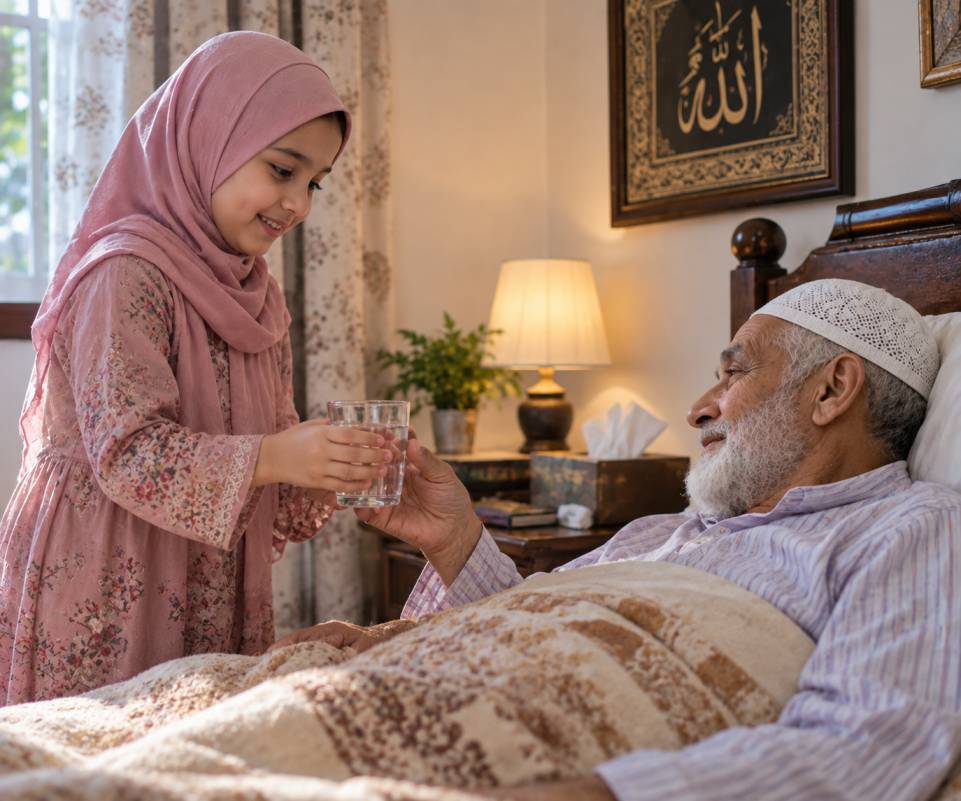
Respect becomes real when it costs something — time, comfort, or attention given to an elder who needs it.
Anas ibn Malik served the Prophet ﷺ for ten years and reported that he was never once rebuked with "uff," never asked why he had done something or why he had left something undone (Sahih al-Bukhari 6038; Sahih Muslim 2309). The adult who most deserved deference was the one who gave it most freely.
Try this week
Pick one recurring moment of friction — the "five more minutes" negotiation, or being called for dinner. For one week, respond to your child in that moment with the tone you want returned to you. Then name it out loud: "Did you notice I didn't raise my voice? That's what I'm asking from you too."
2. Gratitude — Shukr
Shukr is recognizing a blessing, attributing it to Allah, and letting that recognition change your behavior. It is three steps, and most children stop at zero. "Say thank you" trains the word; it does not train the recognition.
لَئِن شَكَرْتُمْ لَأَزِيدَنَّكُمْ
"If you are grateful, I will surely increase you."
Qur'an 14:7
Gratitude is the hardest of the seven to teach in a Western context, and the reason is structural, not moral. Your child lives inside an economy engineered to manufacture dissatisfaction. Every advertisement, every feed, every unboxing video delivers the same message: what you have is not enough. Gratitude is not a small politeness lesson here — it is counter-programming.
The prophetic remedy is directional. When the eye is pointed upward at those with more, it produces resentment. Pointed downward, it produces contentment:
"Look at those below you and do not look at those above you, for it is more fitting that you not belittle the favor of Allah upon you."
Sahih al-Bukhari 6490; Sahih Muslim 2963
And gratitude toward Allah is not separable from gratitude toward people: "Whoever does not thank people has not thanked Allah" (Sunan Abi Dawud 4811; Jami' at-Tirmidhi 1954 — hasan sahih).
Try this week
At dinner, each person names one thing that went right today and says Alhamdulillah out loud — but the rule is it cannot be a possession. It must be a person, an ability, or a moment. This breaks the reflex of equating blessing with acquisition.
3. Kindness — Rifq
Rifq is gentleness in handling: choosing the softer approach when a harder one is available and would also work. It shows in tone of voice, in how a child handles a younger sibling, and — revealingly — in how they treat animals, who cannot complain and cannot retaliate.
"Indeed, Allah is gentle and loves gentleness. He gives for gentleness what He does not give for harshness."
Sahih Muslim 2593
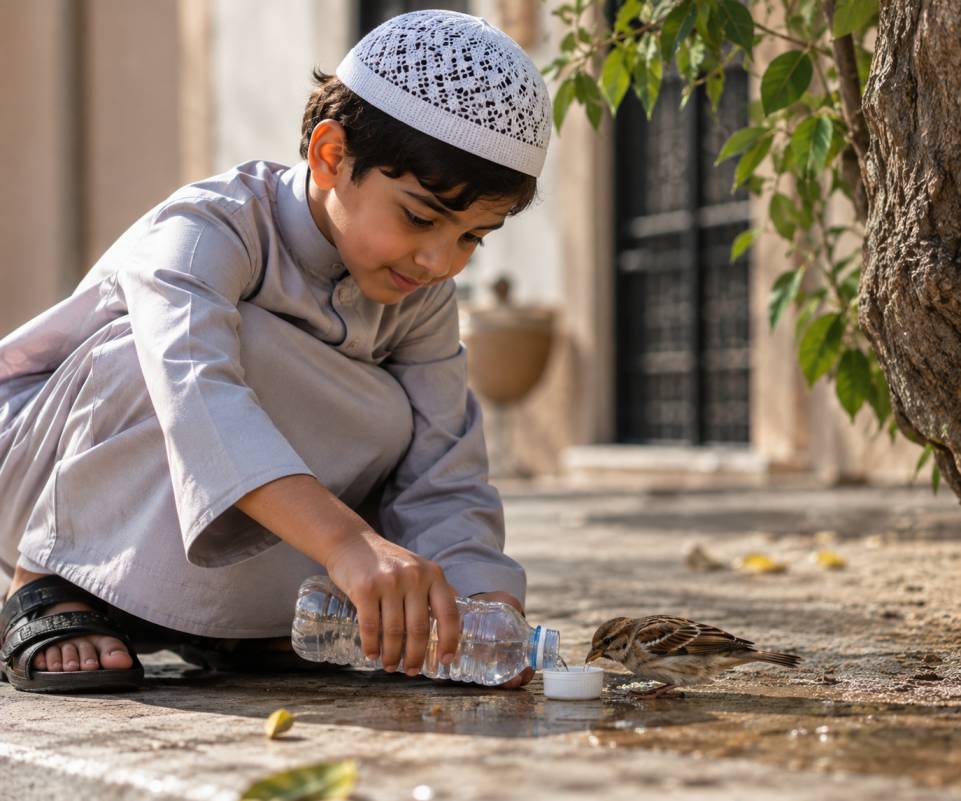
How a child treats an animal is the clearest window into their character — there is no audience to perform for and no consequence to fear.
Islam's treatment of animals gives you two stories that land powerfully with children of almost any age. A woman was punished in the Fire over a cat she confined until it died of hunger (Sahih al-Bukhari 3482; Sahih Muslim 2242). And a man was forgiven entirely for climbing into a well to bring water to a dog dying of thirst (Sahih al-Bukhari 2363).
Tell both. Together they teach something a lecture cannot: that a small act toward a creature nobody is watching can determine an eternal outcome. Children remember this.
Try this week
Give your child responsibility for one living thing — a pet's water bowl, a plant, feeding birds. Daily, unsupervised, theirs. Rifq is learned through custody, not instruction.
4. Empathy — Rahmah
Rahmah is the ability to feel what another person is feeling and to be moved to act by it. Kindness is the behavior; empathy is the engine underneath it. A child can be trained to be polite without ever developing empathy — and that child becomes an adult with excellent manners and no mercy.
"The merciful are shown mercy by the Most Merciful. Be merciful to those on the earth, and the One above the heavens will be merciful to you."
Sunan Abi Dawud 4941; Jami' at-Tirmidhi 1924 — graded hasan sahih
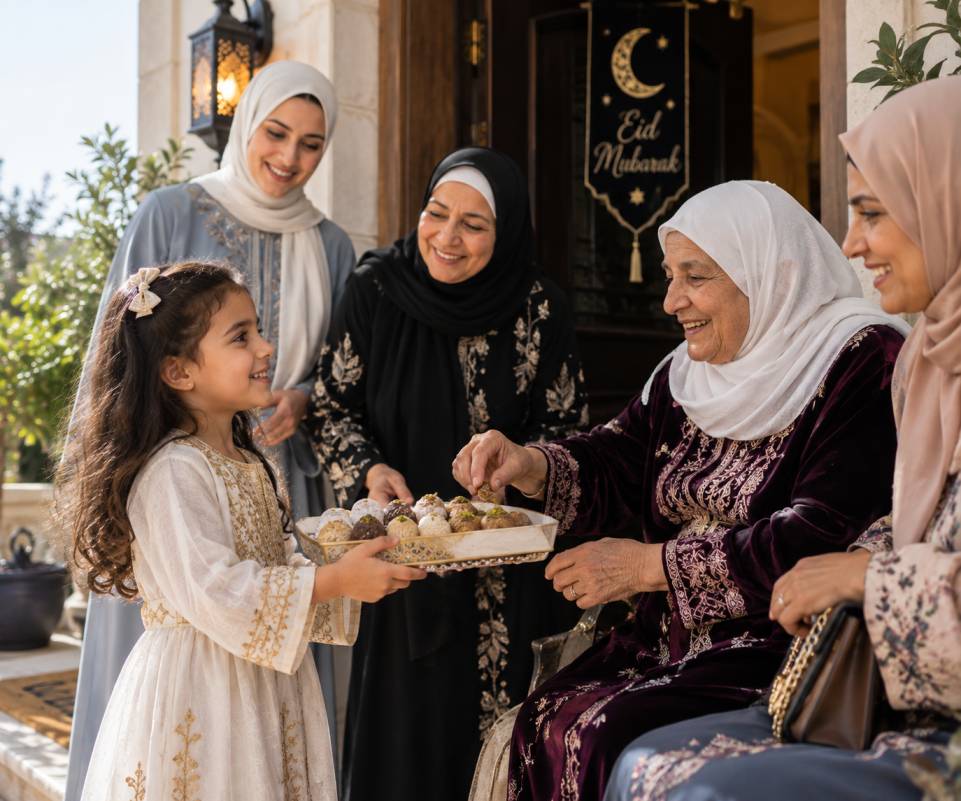
Empathy becomes visible the moment a child gives up something of their own — not a spare, but something they wanted to keep.
The Prophet ﷺ described the believing community as a single body: when one part suffers, the whole body responds with fever and sleeplessness (Sahih al-Bukhari 6011; Sahih Muslim 2586). This is a physical metaphor for a reason. Empathy is not supposed to be an opinion you hold about suffering. It is supposed to be a reaction you cannot suppress.
There is a man in the narrations who told the Prophet ﷺ that he had ten children and had never kissed one of them. The reply was direct: "Whoever does not show mercy will not be shown mercy" (Sahih al-Bukhari 5997; Sahih Muslim 2318). Note what is happening — a father is being corrected for withholding affection. Empathy is taught downward before it is expected upward.
Try this week
When your child reports a conflict at school, resist solving it. Ask one question first: "How do you think the other person felt?" If they cannot answer, that is the lesson for the week — not the conflict.
5. Honesty — Sidq
Sidq is the alignment of speech, action, and inner reality — telling the truth especially when it costs something. Truth that costs nothing is not yet a character trait.
"Truthfulness leads to righteousness, and righteousness leads to Paradise. A man keeps telling the truth until he is recorded with Allah as truthful."
Sahih al-Bukhari 6094; Sahih Muslim 2607
Here is the practical reality every parent needs: children lie primarily because lying works and telling the truth has been punished. If confessing produces the same consequence as being caught, plus a lecture, you have taught your child that honesty is strictly inferior to concealment. They are not being immoral. They are being logical.
The fix is structural. The consequence for a wrongdoing confessed must be visibly, reliably lighter than the consequence for the same wrongdoing discovered. Say it out loud so they know the rule exists. We unpack the full method, including the five roots that make honesty stick, in our dedicated guide on teaching honesty to Muslim children.
6. Patience — Sabr
Sabr is holding yourself steady when your impulse pulls the other way — in hardship, in waiting, and in anger. For children, the anger dimension is the one that matters daily.
"The strong man is not the one who overcomes people in wrestling. The strong man is the one who controls himself when he is angry."
Sahih al-Bukhari 6114; Sahih Muslim 2609
This narration is unusually well-suited to children because it redefines strength in a way they find genuinely surprising. Most children, especially boys, are absorbing a definition of strength from playgrounds and screens that is entirely about dominance. Being told that the actual strong person is the one who didn't swing reframes self-control as an achievement rather than a restriction.
Teach it as a skill with steps, not as a demand: notice the feeling rising, say A'udhu billahi min ash-shaytan ir-rajim, sit down if standing, drink water, then speak. A child cannot execute "calm down." A child can execute a sequence.
7. Responsibility — Amanah
Amanah is trustworthiness: honoring what has been placed in your care, whether an object, a secret, a promise, or a duty.
إِنَّ ٱللَّهَ يَأْمُرُكُمْ أَن تُؤَدُّوا۟ ٱلْأَمَٰنَٰتِ إِلَىٰٓ أَهْلِهَا
"Indeed, Allah commands you to render trusts to whom they are due."
Qur'an 4:58
The Prophet ﷺ listed betraying a trust among the three signs of hypocrisy, alongside lying and breaking promises (Sahih al-Bukhari 33; Sahih Muslim 59). That is severe placement, and it tells you how seriously reliability is weighted.
Amanah is also the only one of the seven that cannot be taught without giving something up. A child learns responsibility by being given real responsibility — a task where failure produces a visible, natural consequence. If you always step in before anything goes wrong, you have protected the outcome and eliminated the lesson.
Try this week
Assign one household duty that genuinely matters and that nobody else will quietly cover. If it isn't done, let the gap be visible. Then discuss it — without rescuing and without shaming.
Akhlaq by Age: What to Expect at Each Stage
The single most common cause of frustration in Islamic parenting is age mismatch — expecting a five-year-old to demonstrate a character trait that is developmentally out of reach, then treating the failure as defiance.
| Value | Ages 3–5 | Ages 6–9 | Ages 10–13 | Ages 14+ |
|---|---|---|---|---|
| Respect | Says salaam; doesn't hit | Doesn't interrupt; obeys first ask | Disagrees without contempt | Respects absent authority |
| Gratitude | Says Alhamdulillah | Thanks specific people | Notices what others do for them | Content without comparing |
| Kindness | Gentle with pets and babies | Shares without prompting | Kind to those with no status | Kind when it costs social capital |
| Empathy | Notices someone is sad | Names another's feeling | Changes behavior because of it | Acts on behalf of the unseen |
| Honesty | Tells what happened | Confesses when asked | Confesses before being asked | Truthful when it costs them |
| Patience | Waits a short turn | Handles "no" without meltdown | Manages anger with a method | Endures long difficulty |
| Responsibility | Puts own toys away | Owns one daily task | Keeps promises unprompted | Accountable without oversight |
Each stage has its own leverage points and its own failure modes. Our stage-specific guides go far deeper than this table allows:
- Islamic tarbiyah for children aged 5–7 — the imitation years, where modeling does almost all the work
- Tarbiyah for ages 8–10 — when fairness, rules, and consistency become everything
- The 11–14 stage — where "because I said so" stops working and reasons become mandatory
- Guiding teenagers aged 15–18 — the shift from enforcement to mentorship
How the Prophet ﷺ Taught Akhlaq to Children
The prophetic method with children is documented in enough detail to be reconstructed. Four features stand out, and all four run against parental instinct.
He corrected in the moment, briefly, once
Umar ibn Abi Salamah was a young boy whose hand wandered across the serving dish. The Prophet ﷺ told him: say Bismillah, eat with your right hand, and eat from what is nearest you. Umar reported that this remained his manner of eating for the rest of his life (Sahih al-Bukhari 5376; Sahih Muslim 2022). Three instructions, delivered once, at the exact moment of the error. No lecture. No reference to it later.
He let children interrupt his most sacred moments
The Prophet ﷺ prolonged a prostration because his grandson had climbed onto his back, and he would not hurry him off (Sunan an-Nasa'i 1141 — graded sahih). A child who is treated as an interruption learns that they rank below your schedule. He refused to teach that lesson even in salah.
He took children's small concerns seriously
He would greet a young boy with a joke about his pet bird — "Abu Umayr, what happened to the little nughayr?" (Sahih al-Bukhari 6129; Sahih Muslim 2150). A child's grief over a bird is small to an adult. He did not treat it as small.
He corrected adults in front of children, gently
When a bedouin urinated in the mosque, the Companions moved to stop him harshly. The Prophet ﷺ told them to leave him, then had water poured over the spot and explained to the man kindly (Sahih al-Bukhari 6025). Children in the vicinity learned more about akhlaq from watching that response than from any instruction about it.
7 Ways to Teach Akhlaq at Home That Actually Work
- Model it where it is expensive. Children discount manners you display toward guests. They weigh heavily the manners you display when you are tired, late, or wrong. How you speak to a rude customer service agent teaches more than a hundred reminders.
- Name the value, not just the behavior. "Don't grab" teaches an action. "That was your sister's turn — waiting is sabr, and Allah is with the patient" teaches a category the child can apply somewhere new.
- Catch it happening. Most character feedback children receive is negative, which trains them to hide rather than to improve. Deliberately notice the good instance out loud, and be specific: "You let him go first even though you were there. That's exactly it."
- Use stories over lectures. A lecture triggers defensiveness; a story does not. The woman and the cat, the man and the thirsty dog, Anas and ten years without a rebuke — these do work a lecture cannot.
- Make the consequence match the value. If a child was unkind, the repair should be an act of kindness, not a removed screen. Consequences that teach are the ones connected to what was broken.
- Repair visibly when you get it wrong. Apologize to your child when you overreact, and say why. This teaches that akhlaq is a standard binding on everyone, not a set of rules for small people.
- Keep it short and constant. Five minutes daily beats an hour on Sunday. Character is built by frequency, not duration.
The 30-Day Family Akhlaq Plan
Trying to work on all seven values at once produces nothing. This plan takes one focus per week, keeps the previous weeks running in the background, and requires about ten minutes a day.
Week 1 — Respect
Focus: tone of voice inside the house. One family rule announced on day one: nobody in this house is spoken to in a tone we would not use with a guest. Parents included. At bedtime, one question: "Did anyone's tone hurt you today?"
Week 2 — Gratitude
Focus: naming blessings that are not possessions. One at dinner, every night, from every person. On day seven, each child writes or says a thank-you to one specific person and delivers it.
Week 3 — Kindness and Empathy
Focus: one act for someone else each day — a sibling, a neighbor, an animal. The act must cost something small: time, a turn, or a possession. Discuss at night: how do you think they felt?
Week 4 — Honesty and Patience
Focus: announce the confession rule explicitly — telling us before we find out always makes the consequence lighter, and it always will. Pair it with the anger sequence: notice, seek refuge, sit, drink, speak.
After 30 days
Do not start over with new values. Keep the four practices running and add responsibility in month two by assigning each child one real, unsupervised duty. Character work compounds; it does not reset.
When It Isn't Working: Common Akhlaq Problems and What to Do
This is where most parents actually live, and where most articles go quiet. Four situations account for the majority of what we hear from families.
"My child lies even about small things"
Check the incentive structure before checking the child. If confession and discovery lead to the same punishment, lying is the rational choice. Make the difference real and state it openly. Also examine whether you are asking questions you already know the answer to — "Did you take it?" when you watched them take it is an invitation to lie, not a test of honesty.
"My child is polite outside and awful at home"
This is developmentally normal and a genuine signal of safety — children release control where they feel secure. It is still not acceptable. Address it as a standard rather than a betrayal: "I know home feels easier. The standard is the same here. Actually, it's higher here, because these are the people Allah has given you the most rights over."
"My child is unkind to a sibling specifically"
Almost always a competition problem, not a kindness problem. Audit whether one child is regularly compared to the other, even favorably. The Prophet ﷺ instructed a father who had given one child a gift and not the others to reverse it: "Fear Allah and be just between your children" (Sahih al-Bukhari 2587; Sahih Muslim 1623). Perceived unfairness poisons sibling kindness faster than anything else.
"We teach it and nothing changes"
Two likely causes. First, the value is being taught at the wrong developmental level — check the age table above. Second, and more common, the behavior is modeled inconsistently by adults. Children calibrate to what is done, not what is said, and a single loud contradiction outweighs a week of instruction. If you have been at it consistently for a month with no movement, look at the household before looking at the child — and see our breakdown of the single biggest mistake in Islamic parenting.
8 Mistakes Parents Make When Teaching Akhlaq
- Teaching manners as rules with no reason attached. Rules without reasons survive only as long as supervision does.
- Correcting character publicly. Correcting a child in front of siblings or guests produces shame, and shame produces concealment rather than change.
- Demanding respect while not extending it. Shouting at a child to teach them not to shout teaches the opposite of the stated lesson.
- Prioritizing memorization over behavior. When a child sees that completing a juz' is celebrated and lying is shrugged off, they learn exactly which one the family values.
- Inconsistency between parents. If one parent enforces and the other overrules, the child learns to negotiate rather than to internalize.
- Using Allah as a threat. "Allah will punish you for that" repeated as a disciplinary tool builds fear attached to the wrong object. Connect akhlaq to Allah's love and pleasure far more often than to His punishment.
- Expecting a linear curve. Character regresses during transitions — new school, new sibling, puberty. Regression is not failure.
- Waiting for the teenage years. The imitation window from ages three to seven is when character is cheapest to build. By fifteen you are renovating rather than constructing.
Akhlaq in the Digital World
Your child's most frequent social interactions may not happen in person. Islamic manners are not suspended because a screen is involved, but the classical examples do not map automatically and children notice the gap.
- The tongue includes the keyboard. Backbiting in a group chat is backbiting. A cruel comment on a post is cruelty, with a wider audience.
- Silence is a choice. Watching a classmate get mocked in a chat and saying nothing is participation. Teach the minimum: leave, or speak.
- Presence is adab. A phone on the table during a conversation communicates that the person is secondary. This applies to parents first.
- Truth includes what you share. Forwarding something false is spreading falsehood, whether or not you invented it.
- Others' privacy is an amanah. A photo or screenshot of someone else is a trust. Sharing it without permission is a betrayal of that trust.
How to Know It's Working
Character progress is slow and easy to miss. These are the markers worth watching for, roughly in order of difficulty:
- The behavior appears when you are not in the room
- Your child corrects themselves without being prompted
- Your child applies a value to a situation you never discussed
- Your child confesses something before you discover it
- Your child extends kindness to someone who offers them nothing back
- Your child uses the Islamic vocabulary on their own — naming something as sabr or amanah without prompting
The fourth and fifth are the strongest signals. Both involve a cost with no observable reward, which means the motivation has moved inward. That is the moment adab has become akhlaq.
Frequently Asked Questions
At what age should I start teaching akhlaq to my child?
Start at age three, when imitation is at its peak and children absorb behavior without instruction. Formal explanation can begin around age six or seven, when children start to understand rules and reasons. The ages of three to seven are the highest-leverage window, because character formed then requires reinforcement rather than reconstruction.
What is the difference between adab and akhlaq?
Adab is outward etiquette — the correct action in a given situation, such as saying Bismillah before eating or not interrupting an elder. Akhlaq is the inner character that makes the correct action natural. Adab can be trained through repetition; akhlaq grows through modeling, explanation, and experience over years. Teaching adab is the path to building akhlaq.
What are the most important Islamic manners to teach a child?
Seven values cover a child's relationships with Allah, family, peers, and creation: respect (ihtiram), gratitude (shukr), kindness (rifq), empathy (rahmah), honesty (sidq), patience (sabr), and responsibility (amanah). Each has a direct Qur'anic or prophetic foundation and each is teachable from early childhood.
How do I teach akhlaq when my child's school teaches different values?
Name the difference explicitly rather than leaving your child to reconcile it alone. Acknowledge what the school teaches, explain where Islam agrees, and be specific about where it differs and why. Children are not confused by holding two frameworks — they are confused when nobody tells them there are two, and which applies where.
Why does my child behave well outside the house but badly at home?
This is developmentally normal and signals that home feels safe enough to release self-control. It is still worth correcting. Frame it as a standard rather than a betrayal: the same behavior is required at home, and arguably more so, since family members have the greatest rights over one another in Islam.
How long does it take to see a change in a child's character?
Small behavioral changes commonly appear within four to six weeks of consistent daily practice. Genuine internalization — behavior that holds when no one is watching — typically takes months to years and progresses unevenly, with regression during transitions such as a new school or the onset of puberty. Frequency matters more than intensity: ten minutes daily outperforms an hour weekly.
Should I punish my child for bad manners?
Correct rather than punish, and keep the correction connected to what was broken. If a child was unkind, the repair should be an act of kindness rather than an unrelated removed privilege. Correct privately, briefly, and once. Public correction produces shame, and shame teaches concealment rather than character.
How can online Islamic classes help with my child's akhlaq?
Structured classes reinforce at home what a teacher models in the lesson, give the child an adult outside the family whose example carries weight, and embed character explicitly in the curriculum rather than leaving it implicit. The effect is strongest when the teaching connects every manner back to the Qur'an and the Sunnah rather than presenting manners as social convention.
Build Your Child's Character With Teachers Who Live It
At Sirat Academy, akhlaq is not a topic at the end of the syllabus. It is woven through every Qur'an, Arabic, and Islamic Studies lesson we teach. Try two free classes and see the difference for yourself.
Book 2 Free Trial ClassesExplore our Islamic Studies course →