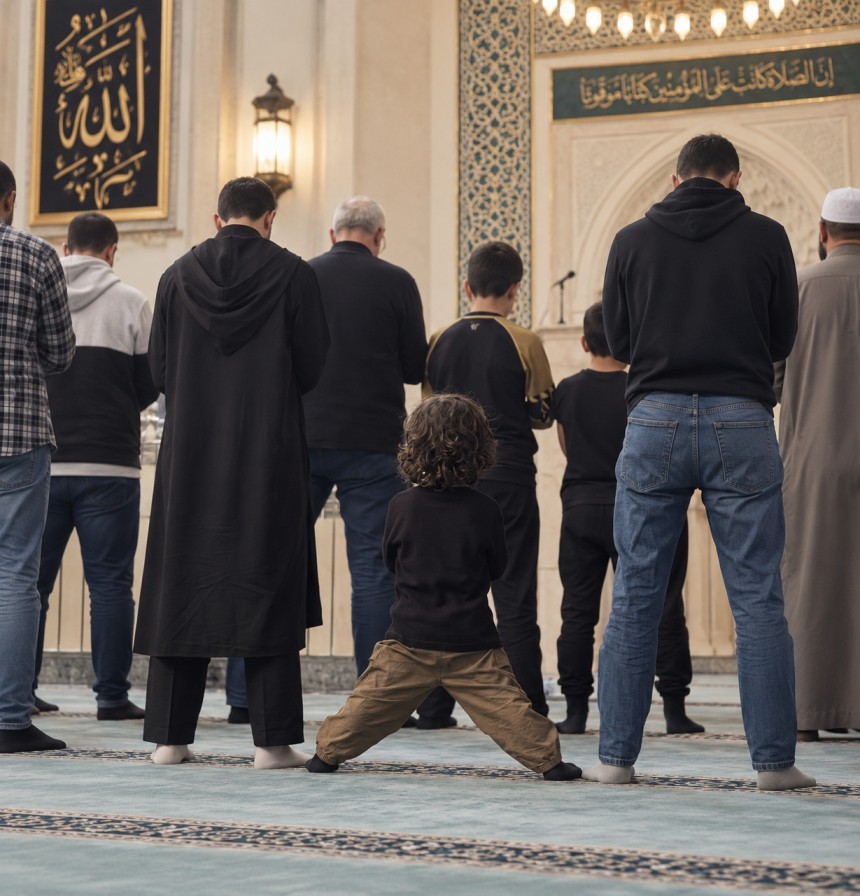
How to Teach Your Child to Pray (Salah): A Step-by-Step Guide for Muslim Parents
A warm, complete roadmap for raising children who not only perform salah — but understand it, love it, and hold on to it while growing up in the West.
Rihana sat at her kitchen table in Manchester, watching Fatima (8) do her homework and Ahmed (7) build a tower of blocks. A quiet worry had been growing in her chest for weeks: “They’re getting older. It’s time they learned to pray properly — but where do I even start, and how do I do it without pushing them away from it?”
If you have ever felt Rihana’s mix of love, urgency, and uncertainty, you are exactly who this guide is written for. Teaching a child salah is one of the most rewarding responsibilities a Muslim parent carries — and it becomes far less overwhelming when you have a clear, gentle, step-by-step plan instead of a vague sense of pressure.
To teach a child salah, start by building love for prayer and explaining why Muslims pray, then teach wudu, the five daily prayers, the correct prayer positions, and the essential words and recitations. Gradually explain the meaning of what they recite, practise complete prayers together, establish a daily routine, and encourage the child until they can pray correctly, understand salah, and perform it independently.
This is the pillar guide in our Islamic Studies series. Below, each building block of salah is introduced clearly and — where a topic deserves its own deep dive — linked to a dedicated supporting guide. Use the table of contents to jump to what you need.
SECTION 01Why should children start learning salah early?
Children should learn salah early because prayer is the foundation of a Muslim’s daily faith and identity. Introducing it young — through gentle exposure before the age of seven — helps a child associate prayer with love and belonging rather than obligation, builds a lasting habit, and anchors their sense of who they are, especially when growing up as a minority in the West.
Rihana realised her worry wasn’t really about the movements of prayer — it was about identity. “Will they feel proud to be Muslim, or embarrassed?”
Salah is the second pillar of Islam and the first act a person is questioned about on the Day of Judgement. But beyond its immense reward, daily prayer gives a child something priceless while growing up surrounded by different values: a steady rhythm, a private line to Allah, and a clear answer to the question “Who am I?” A child who prays five times a day carries their identity with them everywhere — to school, to the playground, to a sleepover.
Teaching salah early is also teaching character. The discipline, gratitude, humility, and mindfulness woven into prayer shape the whole child. If you want to go deeper on nurturing that inner foundation, see our guide on teaching Islamic values to children.
SECTION 02At what age should a child start praying in Islam?
The Prophet ﷺ instructed parents to teach children to pray at age seven, and to be firm about it by age ten. This is a gentle window, not a deadline: from ages three to six you introduce the movements playfully, at seven you begin formal instruction, by ten you build firm consistency, and in the teenage years you hand over ownership of the prayer.
“Fatima is eight and Ahmed is seven,” Rihana thought. “Am I already behind?” She wasn’t — she was right on time.
The prophetic guidance gives a beautiful, stress-free roadmap. It doesn’t demand a perfect prayer overnight; it describes stages that match how children actually grow. Here is that window as a simple age-by-age plan:
| Age stage | Your goal | What to focus on |
|---|---|---|
| 3–6 | Exposure & imitation | Let them watch and copy you, name the prayer times, learn simple phrases through play. |
| 7–9 | Formal instruction | Teach wudu, the positions, and Surah Al-Fatiha. Begin praying the daily prayers together. |
| 10–12 | Consistency & accountability | Be firm but gentle. Build the full five-prayer habit and light personal responsibility. |
| 13+ | Ownership | Connect prayer to identity and purpose. Guide lapses with wisdom, not punishment. |
Each of these stages has its own emotional world and its own teaching approach — we break them down in detail across our age-specific parenting guides linked throughout this series.
SECTION 03How do you teach salah without forcing your child?
Teach salah without force by leading through your own example, making prayer feel warm and welcome rather than a punishment, and connecting it to love for Allah instead of fear. Pray in front of your child, invite rather than command, praise every effort, and never tie prayer to anger or threats — so the child chooses prayer because they feel it belongs to them.
This was Rihana’s deepest fear: that pushing too hard would make her children resent the very thing she loved most.
Children absorb our actions far more than our words. When they see a parent stop everything to pray with calm and focus, they learn that salah matters — without a single lecture. So the first “method” is simply to let them see you pray, and to invite them in: “Come stand next to me for Maghrib.”
Avoid the single most damaging mistake: linking prayer to fear, shame, or punishment. A child who is scolded at prayer time learns to dread it. Replace “Get up and pray or else!” with “The sun is rising — come earn the reward of Fajr with me.” Praise sincerely, hug often, and make dua for them out loud.
This gentle-but-consistent balance is the heart of good tarbiyah. We go much deeper in two companion guides: how to make your child love Islam, and the biggest Islamic parenting mistake to avoid.
SECTION 04What does a child need to learn to pray?
To pray, a child needs to learn five building blocks: making wudu (purification), facing the qibla (direction of the Ka‘bah), reciting Surah Al-Fatiha and short surahs, performing the prayer positions in order (standing, bowing, prostrating, sitting) with their words, and reciting the tashahhud while sitting. Each block is taught one at a time until the full prayer comes together.
Rihana felt calmer once she saw salah wasn’t one giant task — it was a handful of small, teachable pieces.
Think of salah as five building blocks. You don’t teach them all at once; you introduce one, practise it during real prayers, then add the next. Here is the map — each block will be explained in full in its own dedicated guide.
1. Wudu
Purification before prayer — washing the hands, mouth, nose, face, arms, wiping the head, and washing the feet. Make it playful and let them splash a little. Full wudu guide for kids →
2. Qibla
The direction we face — towards the Ka‘bah in Makkah. Teach them to check the qibla and stand on a clean prayer mat facing it.
3. Reciting Qur’an
Surah Al-Fatiha is recited in every rak‘ah, so it’s learned first — followed by short surahs like Al-Ikhlas, Al-Falaq, and An-Nas.
4. The positions
Standing (qiyam), bowing (ruku‘), prostrating (sujud), and sitting (julus) — each with its own words, practised in order.
5. The tashahhud
The testimony recited while sitting near the end of the prayer, sending peace upon the Prophet ﷺ and the righteous. Teach the tashahhud to kids →
A quick reference for the words said in each position (Arabic with transliteration) helps children — and parents who are still learning themselves:
- Standing (qiyam): recite ٱلْفَاتِحَة then a short surah.
- Bowing (ruku‘): سُبْحَانَ رَبِّيَ الْعَظِيم — Subhāna Rabbiyal-‘Adhīm (×3).
- Rising: Sami‘Allāhu liman hamidah, Rabbanā wa lakal-hamd.
- Prostration (sujud): سُبْحَانَ رَبِّيَ الْأَعْلَىٰ — Subhāna Rabbiyal-A‘lā (×3).
- Sitting (julus): رَبِّ ٱغْفِرْ لِي — Rabbi-ghfir lī (“My Lord, forgive me”).
Deep-dive guides for wudu, Al-Fatiha, the prayer positions, and the tashahhud are part of this Islamic Studies cluster, so your child can master each piece properly — including which parts of wudu are fard and which are sunnah. For the complete prayer shown visually from start to finish, see our illustrated step-by-step guide to salah.
SECTION 05What are the five daily prayers, and how many rak‘ahs is each?
The five daily prayers are Fajr (2 rak‘ahs), Dhuhr (4), Asr (4), Maghrib (3), and Isha (4). Fajr is prayed before sunrise; Dhuhr after midday; Asr in the afternoon; Maghrib just after sunset; and Isha at night. In Fajr — and the first two rak‘ahs of Maghrib and Isha — the recitation is said aloud; the rest are recited silently.
Rihana printed a simple chart and stuck it on the fridge. Within a week, Ahmed was announcing each prayer time like a little muezzin.
| Prayer | Time of day | Rak‘ahs (fard) | Recitation |
|---|---|---|---|
| Fajr — الفجر | Before sunrise | 2 | Aloud |
| Dhuhr — الظهر | After midday | 4 | Silent |
| Asr — العصر | Afternoon | 4 | Silent |
| Maghrib — المغرب | Just after sunset | 3 | First 2 aloud |
| Isha — العشاء | Night | 4 | First 2 aloud |
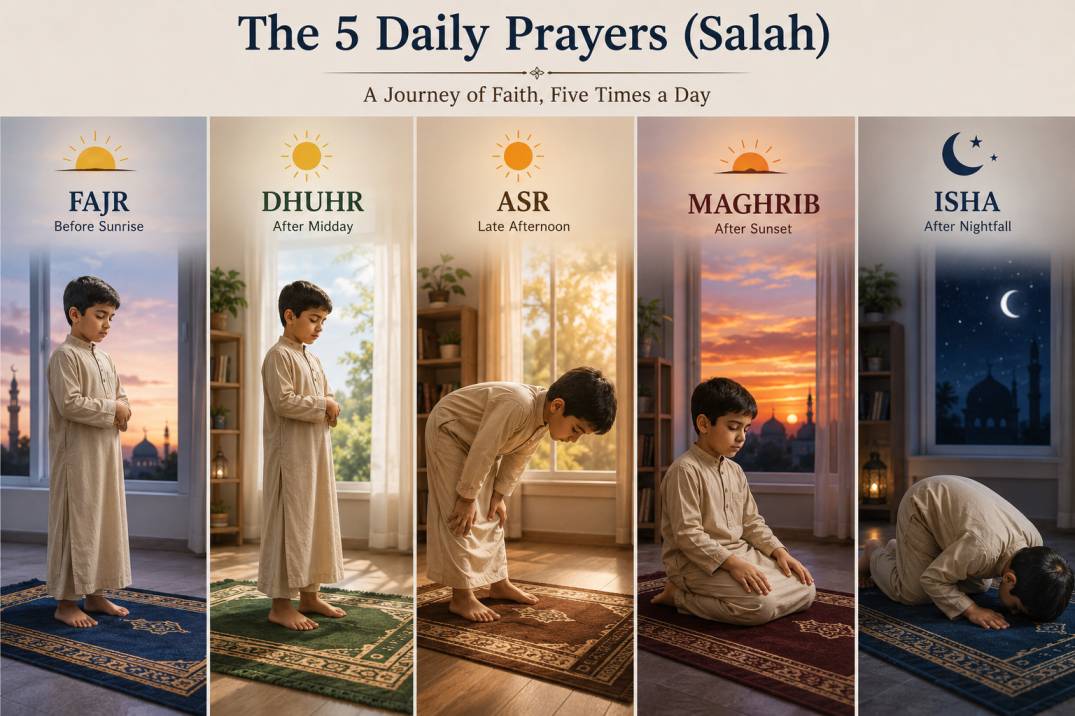
A helpful tip for beginners: don’t start with all five at once. Begin with Fajr and Maghrib, then add the others as the habit settles. Consistency with two prayers beats overwhelm with five.
SECTION 06What other prayers should children learn later?
Once the five daily prayers are established, children can gradually learn other prayers: Jumu‘ah (the Friday congregational prayer), Witr (a recommended night prayer), the two Eid prayers, Duha (the mid-morning prayer), and Salat al-Istikhara (the prayer for seeking guidance). These build on the same positions and words the child already knows, so they come easily later.
When Fatima asked, “Is Eid prayer different, Mama?” Rihana loved that her daughter was already curious for more.
There is no rush here — these are the next chapter. Introduce them naturally as they come up in the year: take your child to Jumu‘ah and the Eid prayer so they feel the joy of the congregation; mention Witr as the “goodnight” prayer; and when they’re old enough to face decisions, teach them Istikhara so they always know they can turn to Allah for guidance. Each of these deserves its own supporting guide, which we cover across the series.
SECTION 07How can I teach salah to my child at home, step by step?
Teach salah at home step by step: build love for prayer first, teach wudu, introduce one prayer position at a time, learn Surah Al-Fatiha, then pray a full short prayer together daily. Establish a fixed routine, use a visual prayer tracker, explain the meaning of the words gradually, and praise consistency until the child can pray independently.
Rihana stopped trying to teach “everything today” and instead picked one small step each week. That changed everything.
- Weeks 1–2 — Build the love & the “why.” Talk about Allah’s love, let them watch you pray, and let them stand beside you without pressure.
- Weeks 3–4 — Teach wudu. Do it together at the sink, narrating each step. Make it fun and repeatable — our step-by-step guide to teaching wudu to kids walks you through it.
- Weeks 5–6 — Learn the positions. Introduce one position at a time with its short phrase, practised during a real prayer.
- Weeks 7–8 — Learn Surah Al-Fatiha. A few lines at a time, reinforced by repetition inside the daily prayer.
- Weeks 9+ — Pray a full prayer together. Start with Fajr and Maghrib, then build to all five as it becomes natural.
- Throughout — Track & celebrate. Use a prayer chart, give sincere praise, and make dua for them out loud.
This gentle sequence works because it never overwhelms the child — each new skill sits on top of one that’s already comfortable. When you reach a full prayer, our illustrated, step-by-step guide to praying salah lets you and your child follow every position and recitation together, one picture at a time.
SECTION 08How do you help a child pray in a non-Muslim school or country?
Help a child pray in a non-Muslim environment by preparing them practically and emotionally: ask the school for a quiet space and time for Dhuhr or Asr, teach them how to pray discreetly and confidently, plan around shifting prayer times (especially long UK summer or winter days), and reinforce at home that praying is something to be proud of, not embarrassed about.
Then came the real test: Fatima whispered, “Mama, what if my friends see me praying and think I’m weird?”
This is the challenge almost no guide addresses — and it’s the one Muslim families in the USA, UK, Canada, and Australia feel most. Teaching the movements is the easy part; helping a child hold on to prayer as a confident minority is the real work.
Practical ways to make salah work in the West
- Talk to the school. Many schools will provide a quiet room and a few minutes for Dhuhr or Asr if you ask — it’s a reasonable, common request.
- Rehearse the moment. Role-play at home how to pray calmly when friends are around, so it feels normal, not nerve-wracking.
- Plan around the clock. In UK winters, prayer times cluster; in summers, Fajr and Isha stretch to the extremes. Teach older children to check times and combine when travelling, per your madhhab.
- Anchor the identity at home. The confidence to pray in public is built by a home where prayer is joyful and belonging is strong.
For the bigger picture of protecting faith and identity abroad, read our dedicated guide: raising Muslim kids in a non-Muslim country.
SECTION 09What do I do when my child refuses to pray?
When a child refuses to pray, stay calm and avoid turning prayer into a battle. Reconnect prayer to love and identity rather than punishment, look for the reason behind the refusal (tiredness, embarrassment, or overwhelm), pray together instead of commanding, keep the standard firm but gentle for children over ten, and be patient — resistance is a normal stage, not a failure.
One evening Ahmed crossed his arms and said, “I don’t want to.” Rihana breathed, and chose patience over panic.
Refusal is normal, especially around age ten and in the teenage years. The worst response is to escalate it into a daily war; the best is to stay warm, consistent, and curious about the cause. A tired child needs rest; an embarrassed child needs reassurance; an overwhelmed child needs you to lower the step size.
- Pray with them rather than sending them off to pray alone.
- Remind them gently of the reward and Allah’s love — not the punishment.
- For teens, hold the standard calmly and have honest one-to-one conversations.
- Never mock or shame a child’s prayer — protect the positive association at all costs.
If refusal runs deeper, it’s usually a sign to invest in the relationship and the “why,” which is exactly what our love-for-Islam guide is built to help with.
Teach your child salah with confidence
Give your child a qualified, caring teacher who makes prayer joyful — with two free trial classes and a personal level assessment. No pressure, no commitment.
FAQFrequently asked questions
At what age should I start teaching my child to pray?
Does my child need to pray all five prayers from the start?
Should I reward my child for praying?
What if I don’t pray consistently myself?
How many rak‘ahs are in each of the five daily prayers?
How do I teach wudu to a young child?
My child gets embarrassed praying in front of non-Muslim friends. What can I do?
What do daughters do about prayer when they reach puberty?
Weeks later, Rihana watched Fatima and Ahmed stand side by side for Maghrib — no reminders, no arguments, just two children who had learned to love their prayer. That is the goal for every family, and it starts with one gentle step today.