 Salah & Worship Habits
Wudu Fard and Sunnah for Kids: A Simple Guide
Wudu (ablution) is the washing Muslims do before Salah, and getting it right is one of the first steps in learning how to pray. This guide teaches kids the Fard and Sunnah of Wudu, what to do if they forget a step, what breaks Wudu, and the Dua to say when they finish.
Fard vs. Sunnah: What Is the Difference in Wudu?
Every action in Wudu belongs to one of two groups. Knowing which is which tells you what to do if something gets missed.
What we must do
An essential action. If a Fard is left out, even by accident, the Wudu is not complete until it is fixed.
What we try to do
What Prophet Muhammad ﷺ regularly did and taught. If it is missed, Wudu still counts, but following it makes Wudu more complete.
What Are the 4 Fard of Wudu?
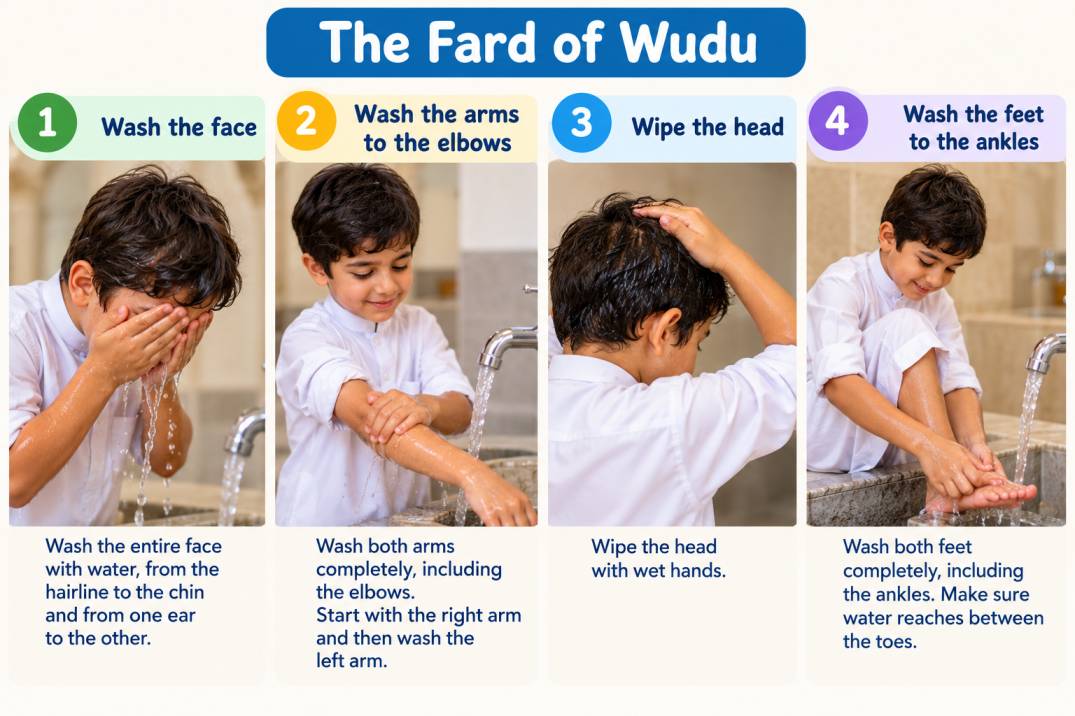
Allah names these four actions in Surah Al-Ma’idah (5:6). They must be done properly every time.
- 1
Wash the face
From the hairline to the chin, and from one ear to the other.
- 2
Wash the arms to the elbows
Wash both arms completely, including the elbows.
- 3
Wipe the head
Pass wet hands over the head.
- 4
Wash the feet to the ankles
Wash both feet, including the ankles, and let water reach between the toes.
Good to know: Some scholars also count the intention (niyyah), keeping the order, and continuity as Fard. Your teacher can guide your child according to the school of fiqh your family follows.
What Are the Sunnah of Wudu?
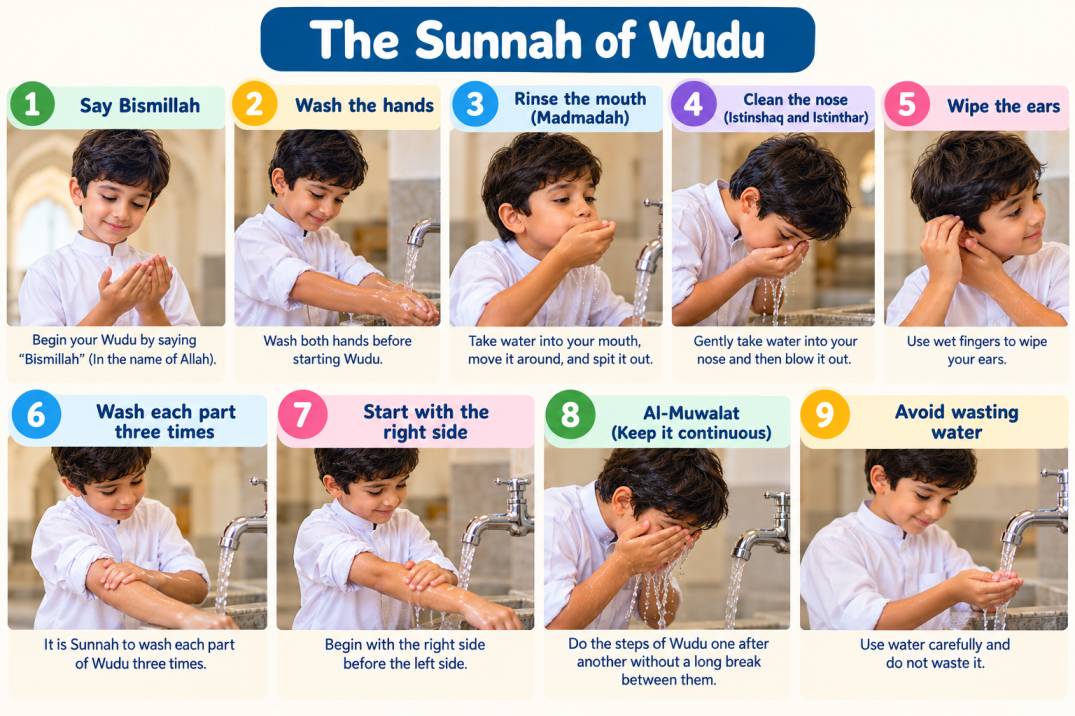
These actions follow the way the Prophet ﷺ made Wudu.
Before you begin
- Say “Bismillah”بِسْمِ اللهِ, “In the name of Allah,” to start the worship for Allah.
- Wash your handsWash both hands well before the main parts of Wudu.
Along the way
- Rinse your mouth (madmadah)Swish water around your mouth, then spit it out.
- Clean your nose (istinshaq and istinthar)Gently sniff water in, then blow it out.Sahih al-Bukhari 159
- Wipe your earsUse wet fingers to wipe inside and behind the ears.
The whole time
- Wash each part three timesOnce is enough for the Fard; up to three times is Sunnah.Sahih al-Bukhari 157 and 159
- Start with the right sideRight arm before left, right foot before left.Sahih al-Bukhari 168
- Keep it continuous (al-muwalat)Finish without long breaks to play, eat, or do something else.
- Don’t waste waterThe Prophet ﷺ made Wudu with about one mudd, a small double handful.Sahih al-Bukhari 201
What If I Forget Something in Wudu?
It depends on what you forgot.
Go back and wash that part properly. Forgot your feet? Wash your feet.
If a long time has passed, or you’re not sure what you missed, it is safer to make Wudu again.
Your Wudu is still valid. Forgot to wipe your ears? No need to start over.
Just try to remember it next time.
When Do I Need to Make Wudu Again?
Only when your Wudu is broken. Common things that break Wudu:
- Using the toilet (urine or stool)
- Passing wind
- Deep sleep where you lose awareness
Touching something dirty does not break Wudu; just wash the dirty spot. And if you only think your Wudu might be broken, don’t keep repeating it. The Prophet ﷺ taught that a person should not leave the prayer over a doubt unless he hears a sound or notices a smell (Sahih al-Bukhari 137). Being sure is not cancelled by a doubt.
What Is the Dua After Wudu?
When you finish, say:
أَشْهَدُ أَنْ لَا إِلٰهَ إِلَّا اللهُ وَحْدَهُ لَا شَرِيكَ لَهُ، وَأَشْهَدُ أَنَّ مُحَمَّدًا عَبْدُهُ وَرَسُولُهُ
Ash-hadu alla ilaha ill-Allah wahdahu la sharika lah, wa ash-hadu anna Muhammadan ‘abduhu wa rasuluh.
I bear witness that there is no god but Allah alone, without any partner, and I bear witness that Muhammad is His servant and Messenger.
Sahih Muslim 234
Many also add:
اللَّهُمَّ اجْعَلْنِي مِنَ التَّوَّابِينَ وَاجْعَلْنِي مِنَ الْمُتَطَهِّرِينَ
Allahumma-j’alni min at-tawwabeena waj’alni min al-mutatahhirin.
O Allah, make me among those who constantly repent and make me among those who purify themselves.
Jami’ al-Tirmidhi 55. Al-Tirmidhi noted a weakness in its chain; later scholars, including al-Albani, graded it authentic.
A Wudu Checklist for Kids
Tap each step as your child completes it. For a parent’s game plan on practicing at home, see how to teach Wudu to kids.
0 of 12 done
Fard
Sunnah
MashaAllah! Your Wudu is complete. You’re ready for Salah.
Wudu is more than washing. It is worship that prepares us to stand before Allah in Salah.
Take your time and practice every day; the more you do it, the more natural it becomes. Once Wudu feels easy, the next step is Salah itself, and our parent’s guide to teaching your child to pray walks you through it. For fun ways to practice at the sink, try our step-by-step Wudu lessons for kids.
Frequently Asked Questions
How many Fard are there in Wudu?
There are four Fard of Wudu named in Surah Al-Ma’idah (5:6): washing the face, washing the arms to the elbows, wiping the head, and washing the feet to the ankles. Some schools of fiqh add the intention, order, and continuity.
Is my Wudu valid if I forget a Sunnah?
Yes. Forgetting a Sunnah, such as wiping the ears or saying Bismillah, does not cancel Wudu according to most scholars. Only a missed Fard has to be fixed.
Does touching something dirty break Wudu?
No. Touching something dirty does not break Wudu. Wash the area that got dirty and continue.
What should I say after Wudu?
Say the Shahadah: “Ash-hadu alla ilaha ill-Allah wahdahu la sharika lah, wa ash-hadu anna Muhammadan ‘abduhu wa rasuluh” (Sahih Muslim 234). Many also add “Allahumma-j’alni min at-tawwabeena waj’alni min al-mutatahhirin” (Jami’ al-Tirmidhi 55).
Let a Teacher Guide Your Child’s Wudu and Salah
One-to-one live classes with Al-Azhar-qualified teachers, built for Muslim kids growing up in the West. Your first 2 classes are free.