Teaching Islamic Values to Children: How to Raise Kids Who Live Islam Through Real Muslim Heroes and Everyday Actions
“Character isn’t built by lectures. It’s built by the heroes our children choose to follow.”
IntroductionWhere Islamic character really begins
“How do I teach my child Islamic values in today’s world?”
If you’ve ever asked yourself this question, you’re not alone.
Many Muslim parents—especially those raising children in the USA, UK, Canada, and other Western countries—want their children to grow into kind, honest, confident Muslims. Yet teaching Islamic values can feel challenging when children are surrounded by different influences at school, online, and in everyday life.
The good news is that children don’t develop Islamic character simply by memorizing rules. They develop it by watching the people around them, hearing inspiring stories, practicing good deeds, and understanding how Islam applies to everyday situations.
The most effective way to teach Islamic values to children is to combine positive role models, practical daily experiences, stories from the Qur’an and Seerah, and consistent family habits. When these elements work together, Islamic manners become part of a child’s identity—not just something they are told to do.
In this guide, you’ll discover:
- The Islamic values every Muslim child should learn.
- Why children imitate actions more than they follow advice.
- Inspiring stories of real Muslim heroes whose character changed lives.
- Practical activities you can use at home to build honesty, kindness, patience, gratitude, and responsibility.
- Common parenting mistakes that unintentionally weaken Islamic character—and how to avoid them.
Our goal isn’t simply to help your child know Islamic values.
Our goal is to help them live them—with confidence, sincerity, and pride in their Muslim identity.
Let’s begin.
The Question That Matters MostEvery Parent Has the Same Question…
Imagine your son walking home from school.
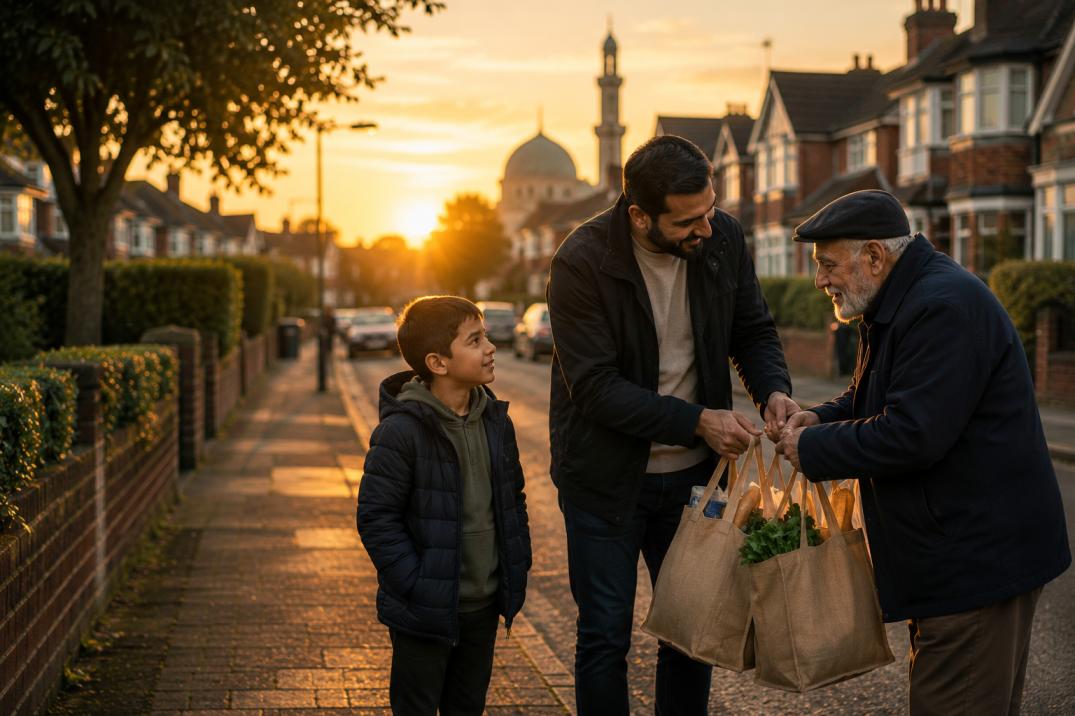
On the sidewalk, he notices an elderly man struggling to carry heavy grocery bags.
No one stops.
People continue walking.
Some glance for a second before looking back at their phones.
Your son hesitates.
Should he help?
Or should he keep walking like everyone else?
Now imagine a different situation.
Your daughter is sitting in class when the teacher asks who accidentally broke a classroom project. She knows exactly who did it.
Her best friend whispers,
“Don’t say anything.”
What will your daughter choose?
Will she protect her friend?
Will she tell the truth?
Or will she stay silent because everyone else does?
These moments rarely appear in parenting books.
Yet they are the moments that define who our children become.
As Muslim parents, we often worry about our children learning the Qur’an, memorizing duas, or performing Salah correctly—and these are all essential parts of raising a Muslim.
But another question deserves just as much attention:
That is where Islamic values reveal themselves.
Honesty.
Mercy.
Courage.
Compassion.
Humility.
Responsibility.
These are not simply words children memorize.
They are choices children make.
Especially when making the right choice is difficult.
For Muslim families living in countries like the United States, the United Kingdom, Canada, or Australia, these moments happen every single day.
Our children spend hours at school.
They scroll through social media.
They watch influencers.
They admire athletes.
They follow YouTubers.
Whether we realize it or not, someone is always teaching our children what courage looks like.
Someone is teaching them what success means.
Someone is teaching them what kindness looks like.
The question is…
Who are those teachers?
Stories Over SermonsWhy Simply Telling Children to “Be Good” Doesn’t Work
Most parents have said something like this:
“Be honest.”
“Share with your sister.”
“Respect your elders.”
“Don’t lie.”
These reminders are important.
But think about your own childhood.
Can you remember every piece of advice your parents gave you?
Probably not.
Yet you probably remember the people you admired.
The teacher who inspired you.
The neighbor who helped everyone.
The grandfather whose words always matched his actions.
Children learn with their eyes before they learn with their ears.
That is why Allah fills the Qur’an with stories instead of commandments alone.
The Qur’an tells us about Prophet Yusuf’s forgiveness.
It tells us about Prophet Ibrahim’s trust in Allah.
It tells us about Prophet Musa’s courage.
It tells us about the patience of Prophet Nuh.
Stories stay in the heart long after instructions are forgotten.
The same principle still works today.
When children meet real Muslim heroes—people who live Islam through their actions rather than simply speaking about it—they begin to understand what Islamic values actually look like.
Not as lessons.
But as a way of living.
Heroes They Can BecomeReal Muslim Heroes Teach Better Than Fictional Superheroes
Children naturally admire heroes.
That is how Allah created them.
Many children know superheroes who can fly.
Others know football stars.
Movie characters.
Online celebrities.
But imagine if your child also admired ordinary Muslims who performed extraordinary acts because of their faith.
Not because they had superpowers.
Not because they wore a cape.
But because Islam shaped their hearts.
Heroes who prayed.
Heroes who served others.
Heroes who acted with courage when everyone else was afraid.
These are the role models that help children understand that Islam is not just something we practice inside the mosque.
It is something we live wherever Allah places us.
And one remarkable story begins in a quiet French town before sunrise.
Hero Story #1 — The Baker Who Saved Seventeen Lives
At 3:54 in the morning, while most of the town was still asleep, a young Muslim baker named Ezzedine Hamdi was already at work.
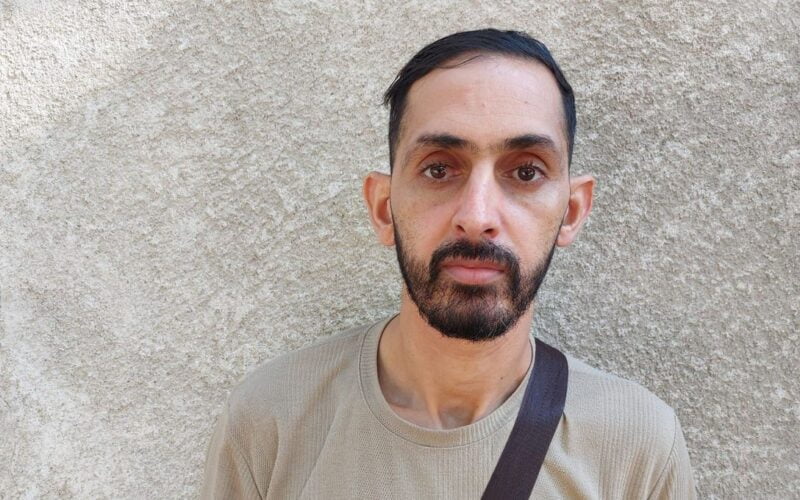
Like every morning, he was preparing fresh bread for the day ahead.
Then he heard screaming.
He rushed outside.
The apartment building above his bakery was on fire.
Flames climbed several meters into the night sky.
Thick black smoke poured from the windows.
Families were trapped inside.
The staircase had already been consumed by the fire.
No one could escape.
Ezzedine immediately called the fire department.
But he knew something.
Every passing second meant another family could lose their lives.
He didn’t wait.
He grabbed a ladder.

Without knowing whether the building would collapse…
Without knowing whether the flames would spread…
Without asking whether someone else would do it…
He climbed.
When he reached one of the windows, a terrified mother handed him her baby.
He carefully carried the child down to safety.
Most people would have stopped there.
Ezzedine didn’t.
Again…
And again…
And again…
He climbed back into the smoke.
Each time bringing another person to safety.
By the time firefighters finally arrived, he had rescued 17 people.
Seventeen mothers.
Fathers.
Children.
Grandparents.
Every one of them survived.
His own bakery was heavily damaged by the fire and water.
Yet when reporters later spoke to him, he wasn’t interested in praise.
He had simply done what he believed was the right thing.
One survivor pointed toward him and said,
“He saved everyone.”
Across France, thousands of people called for him to receive the country’s highest civilian honor.
But perhaps the greatest reward wasn’t a medal.
It was that, on one ordinary morning, a young Muslim quietly showed an entire nation what Islamic character looks like.
What Can We Teach Our Children From Ezzedine’s Story?
Don’t begin by telling your child,
“Be brave like him.”
Instead, invite them into the story.
Ask questions such as:
- What do you think Ezzedine felt when he saw the fire?
- Would it have been easier to stay outside and wait for the firefighters?
- Why do you think he kept climbing back into the burning building?
- What would you have done if you were there?
These conversations help children think rather than simply memorize.
Then connect the story to Islam.
Explain that courage in Islam is not about showing off.
It is about doing the right thing, even when it is difficult.
Mercy is not only something we speak about.
It is something we practice.
Helping others is not limited to our family or friends.
It extends to every human being in need.
Children remember these lessons because they are attached to a real person, a real decision, and a real moment.
They begin to understand that heroes are not fictional characters with extraordinary powers.
Sometimes, they are ordinary Muslims who quietly choose to live by extraordinary values.
Family Reflection Activity
After reading this story together, ask every family member one simple question:
“If Allah gave you one opportunity to help someone this week, what would you do?”
Write everyone’s answers on a piece of paper.
At the end of the week, gather again and talk about what happened.
These conversations do more than teach Islamic values.
They slowly shape the kind of person your child wants to become.
Built Moment by MomentGreat Character Doesn’t Happen by Accident
After hearing Ezzedine Hamdi’s story, many parents naturally think:
“I wish my child would grow up to be someone like him.”
A young Muslim who stays calm under pressure.
Someone who instinctively helps others.
Someone who chooses courage instead of comfort.
But children don’t suddenly become adults with remarkable character.
They become that person because thousands of small moments shaped them long before anyone noticed.
Long before the burning building.
Long before the difficult decision.
Long before the world called them heroes.
Every act of honesty…
Every moment of kindness…
Every opportunity to choose Allah over their own desires…
Those are the moments that quietly build Islamic character.
And that process begins at home.
The Everyday ClassroomIslamic Values Are Learned Through Daily Life—Not Occasional Lectures
Many parents think teaching Islamic values means setting aside time every weekend for an Islamic lesson.
While dedicated learning is important, children rarely develop character during formal lessons alone.
They develop it while living.
When they accidentally break a glass.
When their younger sibling takes their toy.
When they lose a football match.
When they receive a poor grade.
When someone at school laughs at another child.
Every ordinary day contains opportunities to teach extraordinary values.
The Prophet ﷺ didn’t simply tell his companions to become better people.
He guided them through real situations.
He corrected mistakes with wisdom.
He praised good character whenever he saw it.
He transformed everyday experiences into lifelong lessons.
As parents, we can do the same.
Instead of waiting for the “perfect teaching moment,” we can recognize that Allah places dozens of teaching moments in front of us every single day.
Behavior vs. CharacterFrom Advice to Action: A Better Way to Teach Islamic Values
Imagine these two parenting approaches.
Parent One
A child lies.
The parent immediately says:
“Lying is haram. Don’t ever lie again.”
The conversation ends.
The child may obey for the moment.
But has anything really changed inside?
Probably not.
Parent Two
The same child lies.
Instead of immediately becoming angry, the parent gently asks,
“Can I tell you a story?”
The child nods.
The parent tells the story of Prophet Muhammad ﷺ, who was known throughout Makkah as Al-Ameen—the Trustworthy—even before he received revelation.
Then the parent asks,
“Why do you think everyone trusted him?”
The child begins to think.
Finally the parent says,
“Every time you tell the truth, even when it’s difficult, you’re following the example of our Prophet ﷺ.”
Now honesty has become more than a rule.
It has become part of the child’s identity.
That is the difference between teaching behavior and building character.
What Actually WorksFive Simple Principles That Make Islamic Values Stick
Parents often ask,
“What’s the best method?”
There isn’t one magical technique.
Instead, there are five habits that consistently shape children’s hearts.
1. Be the Person You Want Your Child to Become
Children are always watching.
They notice how you speak to your spouse.
How you react when someone cuts you off in traffic.
How you treat waiters.
Whether you keep your promises.
Whether you apologize when you’re wrong.
You may forget these moments.
Your child won’t.
One sincere apology from a parent often teaches humility better than twenty lectures.
Ask yourself:
If my child copies everything I do this week, would I be proud of the adult they become?
2. Explain the “Why” Behind Every Islamic Value
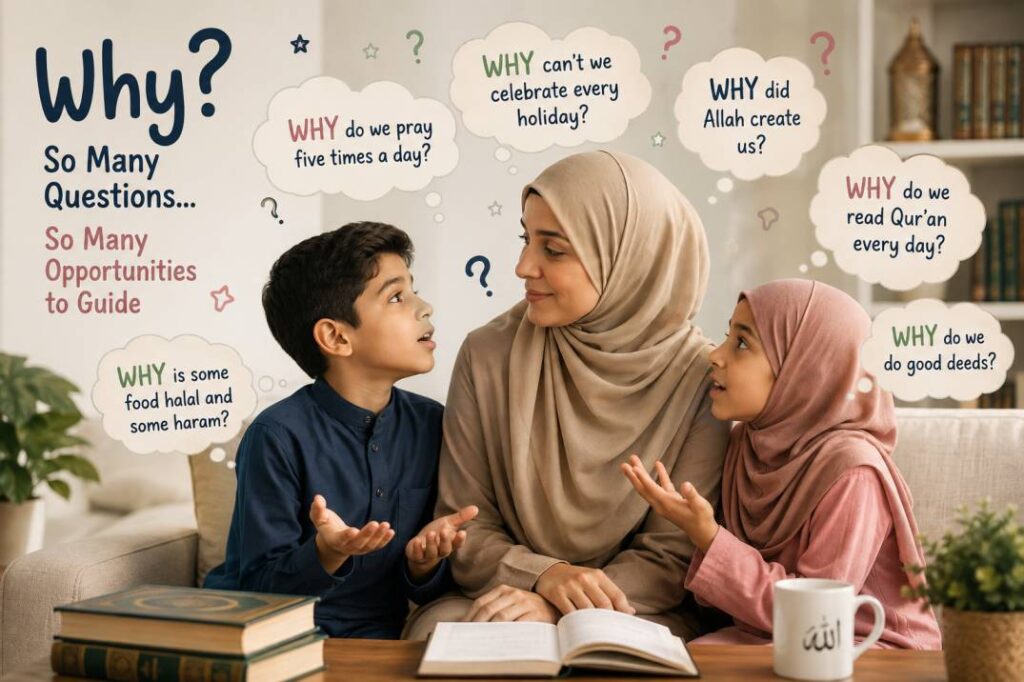
Children naturally ask,
“Why?”
Instead of feeling frustrated, welcome the question.
Don’t simply say,
“Because Islam says so.”
Help them understand the wisdom.
Instead of:
“Share your toys.”
Say:
“Allah loves people who are generous because generosity makes other people feel loved.”
Instead of:
“Respect your grandparents.”
Say:
“They spent years caring for us. Allah teaches us to honor those who cared for us first.”
Children are much more likely to remember values that make sense to their hearts.
3. Ask Questions More Than You Give Answers
One of the greatest teaching tools is curiosity.
Suppose your child watches another student being bullied.
Instead of immediately explaining what Islam teaches, ask:
“How do you think that child felt?”
“What do you think Allah would want us to do?”
“If the Prophet ﷺ had been there, how might he have responded?”
Questions invite children to think.
Thinking develops conviction.
Conviction shapes character.
4. Celebrate Good Character More Than Good Grades
Many children hear things like,
“Great job—you got an A!”
Far fewer hear,
“I’m proud of how honest you were today.”
Imagine how powerful these words become:
“I noticed you shared your snack without anyone asking.”
“You admitted your mistake even though it was difficult.”
“That was a very brave thing to do.”
When parents celebrate Islamic character, children begin to understand what truly matters.
5. Remember That Character Is Built Slowly
No parent plants a seed today and expects a tree tomorrow.
Character grows the same way.
There will be days when your child lies.
Days when they lose their temper.
Days when they forget to say thank you.
These moments don’t mean you’ve failed.
They simply mean your child is still growing.
Allah loves consistency more than perfection.
Keep planting the seeds.
Keep watering them with patience.
One day, you’ll see the fruit.
Hero Story #2 — The Muslim Who Fed More Than 1,500 Healthcare Workers
During the height of the COVID-19 pandemic, hospitals across America were overwhelmed.
Doctors, nurses, and healthcare workers worked exhausting shifts, often with little time to rest or eat.
In Dublin, Ohio, a Muslim community member named Shu al-Hasan saw the same heartbreaking news everyone else did.
But instead of saying,
“Someone should help,”
he asked a different question:
“What can I do?”
Working with the New Islamic and Cultural Center and local partners, he contacted nearby hospitals directly.
His goal was simple.
Feed the people who were spending every day saving lives.
Meals began arriving at hospitals throughout Central Ohio, including the Ohio State University Wexner Medical Center.

One delivery became another.
Then another.
By the end of the initiative, more than 1,500 healthcare workers had received meals through the project.
Healthcare workers expressed heartfelt gratitude, not only for the food but for the reminder that their community stood beside them during one of the hardest moments in modern history.
To recognize his efforts, the Council on American-Islamic Relations (CAIR) Ohio featured Shu al-Hasan in its #OhioMuslimHero campaign.
When asked how he felt about the recognition, his response was beautifully humble.
He explained that the honor wasn’t about receiving attention.
Instead, it reminded him to continue serving others whenever he could.
That simple response teaches one of Islam’s most beautiful lessons:
True service isn’t performed for applause.
It is performed for Allah.
What Can Our Children Learn From Shu al-Hasan?
Unlike Ezzedine Hamdi’s dramatic rescue, Shu al-Hasan never climbed a burning building.
He didn’t make international headlines.
He simply noticed people who needed help.
Then he acted.
This reminds children that becoming a Muslim hero doesn’t always require extraordinary moments.
Sometimes it begins with an ordinary act of kindness.
A warm meal.
A thoughtful visit.
A helping hand.
A sincere smile.
The Prophet ﷺ taught us that even removing something harmful from the road is an act of charity.
Islam celebrates every sincere effort to benefit others, no matter how small it may seem.
Family Reflection Questions
After reading Shu al-Hasan’s story together, ask your child:
- Who helps our community every day without receiving much recognition?
- If you could thank one person this week, who would it be?
- What small act of kindness could our family do before next Friday?
- How do you think Allah rewards people who help others quietly?
There are no perfect answers.
The goal is simply to help children begin seeing the world through the lens of mercy and service.
Family Challenge: Become Everyday Muslim Heroes
This week, choose one simple act of service as a family.
You might:
- Bake cookies for a neighbor.
- Write thank-you cards for teachers.
- Prepare a meal for someone who is ill.
- Visit an elderly relative.
- Collect food for a local charity.
- Help clean your local masjid.
- Secretly leave a gift for someone who is struggling.
When you’re finished, don’t post it on social media.
Don’t look for praise.
Instead, gather together and ask one question:
“How do you think this small act made someone else’s day better?”
That conversation may shape your child’s heart far more than another lecture ever could.
Manners vs. CharacterThe Islamic Values Every Child Should Carry for Life
When parents hear the phrase Islamic values, they often think of a list of good manners.
Be honest.
Be kind.
Respect others.
While these qualities are essential, Islamic values are much deeper than polite behavior.
A child who says “please” and “thank you” has good manners.
A child who chooses honesty even when it leads to consequences has built character.
Our goal as Muslim parents is not simply to raise children who look well-behaved.
Our goal is to raise children whose hearts are guided by Allah.
Children who make the right decision even when nobody is watching.
Children whose values stay with them when they leave home, attend university, begin careers, and eventually raise families of their own.
That kind of character begins with a small number of values practiced consistently throughout childhood.
The FoundationsThe Five Core Islamic Values That Shape Every Other Good Character Trait
Rather than trying to teach dozens of values at once, focus on five foundations.
Almost every beautiful Islamic character trait grows from these roots.
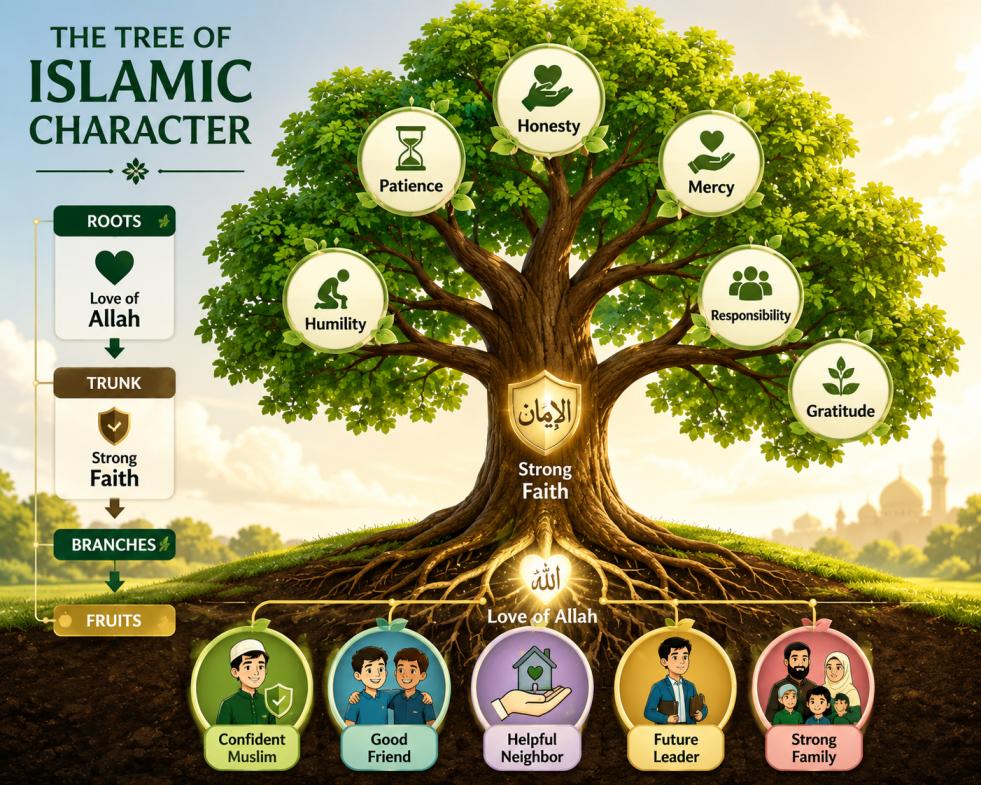
1. Love of Allah
Children naturally obey people they love.
The same is true with their relationship with Allah.
If Islam becomes nothing more than a list of rules, children may obey while they are young but drift away as they grow older.
Instead, help them know Allah through His mercy.
Talk about His blessings.
Notice His creation together.
Celebrate answered duas.
Remind them that Allah loves those who return to Him after making mistakes.
A child who loves Allah doesn’t pray simply because they are told to.
They pray because they want to stay connected to the One they love.
2. Honesty
Truthfulness is one of the first qualities children should associate with being Muslim.
Teach them that honesty is valuable not because it avoids punishment but because it earns Allah’s pleasure.
Praise truthfulness even when it reveals a mistake.
When children admit they broke something or forgot an assignment, thank them for telling the truth before discussing the consequences.
This teaches them that honesty is always respected.
3. Compassion
The Prophet ﷺ showed mercy to children, animals, neighbors, and even those who opposed him.
Help your child notice people who are lonely.
Those who are hungry.
Those who need encouragement.
Compassion grows when children learn to notice the needs of others before thinking only about themselves.
4. Responsibility
Children become responsible by being trusted with responsibility.
Give them meaningful tasks.
Let them water plants.
Help prepare dinner.
Organize their room.
Care for younger siblings.
Every responsibility teaches them that serving others is part of worship.
5. Courage
Courage in Islam is not about being fearless.
It is about doing what is right despite feeling afraid.
Telling the truth.
Standing beside someone being bullied.
Defending another child.
Refusing to cheat.
Remaining proud of Islam even when others question their beliefs.
This is the courage our children need most while growing up in today’s world.
A Living CurriculumThe Seerah Is the Greatest Character Curriculum Ever Written
Many parents read stories from the Seerah before bedtime.
That is wonderful.
But we can go one step further.
Instead of asking,
“What happened?”
Ask,
“What value did the Prophet ﷺ teach us here?”
When reading about the Prophet ﷺ forgiving the people of Makkah, discuss forgiveness.
When reading about his patience in Ta’if, discuss resilience.
When reading about his kindness to children, discuss mercy.
When reading about his honesty before Prophethood, discuss trustworthiness.
Children begin connecting every story to a value they can practice tomorrow.
That is how the Seerah becomes a living guide rather than a history lesson.
Teachable MomentsTurn Everyday Situations Into Character-Building Opportunities
Character isn’t built once a week.
It is built in ordinary moments.
Imagine your child comes home upset because another student was excluded from a game.
Rather than solving the problem immediately, ask:
“How do you think that child felt?”
“What could you do tomorrow to make them feel included?”
Or perhaps your child finds money on the playground.
Instead of simply saying,
“Give it to the teacher,”
ask,
“Why do you think Allah loves people who return what isn’t theirs?”
When your child begins connecting everyday decisions with pleasing Allah, Islamic values become part of the way they think.
Make It a HabitSeven Family Activities That Build Islamic Character
Children remember experiences far longer than lectures.
Here are a few simple traditions that can become part of your family’s routine.
Hero of the Week
Each Friday evening, let every family member nominate someone they saw displaying beautiful Islamic character during the week.
It could be a sibling.
A teacher.
A friend.
Or even someone they read about.
Talk about what made that person inspiring.
The Kindness Jar
Keep a jar in your home.
Whenever someone notices an act of kindness, write it on a small piece of paper and place it inside.
At the end of the month, read every note together.
Children begin searching for goodness instead of mistakes.
Family Seerah Night
Choose one story from the life of the Prophet ﷺ.
After reading it, ask only one question:
“What can we practice this week from this story?”
Focus on one value instead of trying to cover everything.
Secret Charity Mission
Give each child a small amount of money.
Encourage them to help someone without revealing who gave the gift.
Later, discuss how serving others for Allah alone feels different from seeking praise.
Gratitude Before Bed
Before sleeping, ask every family member to mention three blessings from that day.
This simple habit trains children to notice Allah’s countless favors.
Helping Hands Day
Once a month, choose one service activity together.
Visit elderly relatives.
Prepare meals for a neighbor.
Help clean the masjid.
Collect food for families in need.
Children discover that serving others is part of living Islam.
Family Reflection Circle
Once a week, ask one question:
“When did you feel closest to Allah this week?”
Listen without correcting.
The goal is to build trust and reflection.
Avoid TheseCommon Mistakes Parents Make When Teaching Islamic Values
Even loving parents sometimes fall into habits that unintentionally weaken the lessons they hope to teach.
Teaching Rules Before Building Love
Children who understand Allah’s mercy are more likely to obey Him willingly.
Correcting Every Mistake
If every conversation becomes criticism, children stop listening.
Encourage more than you correct.
Expecting Instant Results
Character grows slowly.
Think of yourself as planting seeds.
Some will bloom quickly.
Others may take years.
Forgetting That Children Watch Everything
Your child notices how you treat cashiers.
How you speak about relatives.
Whether you tell the truth.
Whether you apologize.
Your actions are your strongest lesson.
Depending Only on Islamic School
One or two classes each week cannot compete with everything children experience during the other 160+ hours.
The home will always be the greatest classroom.
Parents remain the greatest teachers.
A PartnershipYou Don’t Have to Raise Your Child Alone
Every parent eventually reaches moments of uncertainty.
“Am I doing enough?”
“Am I explaining Islam the right way?”
“Who will reinforce these values when my child isn’t with me?”
That is why a strong partnership between parents and qualified teachers matters.
When children hear the same values at home and during their Islamic education, those lessons become part of who they are rather than information they simply memorize.
At Sirat Academy, this is exactly what we strive to do.
Our Islamic Studies program is not designed to fill children with facts alone.
We help them understand why Muslims pray.
Why honesty matters.
Why kindness is an act of worship.
Why serving others brings us closer to Allah.
Through engaging lessons, authentic Islamic knowledge, stories from the Qur’an and the Seerah, and caring teachers who understand the challenges Muslim families face in Western societies, we work alongside parents to nurture children who are connected to their faith, confident in their identity, and committed to living Islam every day.
Because raising a child of beautiful character is never the responsibility of one teacher or one parent alone.
It is a journey we take together.
In ClosingFinal Thoughts
One day, your child will stand at a crossroads.
Perhaps no one else will be watching.
They will decide whether to tell the truth.
Whether to defend someone being treated unfairly.
Whether to help a stranger.
Whether to remain proud of Islam when it feels easier to blend in.
In that moment, they won’t remember every lecture you gave.
They may not remember every rule you taught.
But if, throughout their childhood, you filled their heart with love for Allah…
If you surrounded them with the stories of the Prophet ﷺ and real Muslim heroes…
If you practiced Islamic values together as a family…
Then, by Allah’s permission, the right choice will no longer feel like a difficult decision.
It will simply be who they are.
And perhaps, years from now, another parent will tell their child the story of an ordinary Muslim who changed someone’s life through courage, compassion, honesty, or mercy.
Without realizing it, that story may be about your son.
Or your daughter.
Start your child’s journey today
Give your child caring, qualified teachers who nurture faith, character, and confidence—one lesson at a time.
Book your 2 free sessionsQuestions Parents AskFrequently Asked Questions About Teaching Islamic Values to Children
1What are the most important Islamic values to teach children?
The most important Islamic values begin with building a strong relationship with Allah. From that foundation, children naturally develop honesty, compassion, patience, gratitude, responsibility, humility, generosity, and respect for others. Rather than trying to teach every value at once, focus on one or two values consistently until they become daily habits.
2At what age should I start teaching Islamic values?
Islamic values can be introduced as early as two or three years old through simple routines, stories, and everyday interactions. Young children learn by watching their parents, so your own actions become their first Islamic education. As they grow older, you can introduce deeper discussions about faith, responsibility, and making ethical decisions.
3How do I teach Islamic values without forcing my child?
Children respond better to inspiration than constant correction. Instead of only telling them what they should do, explain why Allah loves certain behaviors, tell stories from the Qur’an and the Seerah, ask reflective questions, and praise good character whenever you see it. This helps children develop internal motivation rather than simply obeying out of fear.
4How can I teach Islamic values if we live in a non-Muslim country?
Living in a non-Muslim country presents unique challenges, but it also creates opportunities to strengthen your child’s Islamic identity. Build strong family routines around Islam, discuss real-life situations from school or social media, introduce positive Muslim role models, and surround your child with a supportive Muslim community whenever possible. Consistency at home makes a lasting difference.
5What is the best way to teach children honesty in Islam?
Honesty is best taught by example. Let your child see you telling the truth, keeping promises, and admitting mistakes. When your child tells the truth—even after making a mistake—praise their honesty before addressing the behavior itself. Stories from the life of Prophet Muhammad ﷺ, who was known as Al-Ameen (The Trustworthy), also provide powerful lessons.
6Why are stories so effective for teaching Islamic values?
Children naturally connect with stories because they remember emotions more than instructions. Stories from the Qur’an, the Seerah, and real Muslim heroes help children see how Islamic values are lived in real situations. They make concepts like courage, patience, mercy, and generosity easier to understand and imitate.
7How can I make my child love Islamic values instead of just following rules?
Help your child see Islam as a source of love, purpose, and guidance rather than a list of restrictions. Talk about Allah’s mercy, celebrate acts of kindness, explain the wisdom behind Islamic teachings, and create positive family traditions around worship and service. When children experience Islam with joy and meaning, values become part of their identity.
8What are some daily activities that help build Islamic character?
Simple family habits can have a lasting impact. Try reading one Seerah story each week, keeping a kindness journal, volunteering together, making dua for good character, discussing real-life situations through an Islamic perspective, or setting a weekly family challenge to practice one specific Islamic value such as gratitude or generosity.
9What mistakes should parents avoid when teaching Islamic values?
Some of the most common mistakes include focusing only on rules, correcting children more than encouraging them, expecting instant results, neglecting the importance of role modeling, and relying entirely on weekend Islamic classes. Children develop strong character when they consistently see Islamic values practiced at home.
10Can online Islamic Studies classes help reinforce Islamic values?
Yes. A well-designed Islamic Studies program can reinforce the values children learn at home by helping them understand the Qur’an, the Seerah, Islamic manners, and the reasons behind Islamic teachings. When parents and teachers work together, children receive consistent guidance that strengthens both their knowledge and their character.
11How long does it take for children to develop good Islamic character?
Character develops gradually through years of consistent guidance, encouragement, and practice. There is no fixed timeline because every child grows differently. The goal is not perfection but steady progress. Every honest conversation, every act of kindness, and every opportunity to choose what pleases Allah helps shape your child’s character over time.
12How can Sirat Academy help my child develop strong Islamic values?
At Sirat Academy, we believe Islamic education goes beyond memorizing information. Our Islamic Studies program combines authentic knowledge, engaging lessons, stories from the Qur’an and the Seerah, and practical discussions that help children understand how to live Islam in their everyday lives. Working alongside parents, our qualified teachers help children build faith, confidence, and strong Islamic character—so they grow into Muslims who are proud of their identity and guided by Islamic values.